


Welcome to the Where Tech Meets Bio newsletter, where we explore companies, technologies, and scientific breakthroughs shaping the future of medicine!
If this newsletter is in your inbox, it’s because you subscribed, or someone thought you might enjoy it. In either case, you can subscribe directly by clicking this button:
In this issue: The FDA opens the question of how you evaluate a clinical AI that answers differently every time — Network Bio, Harell Data and Lilly's TuneLab each try a different way of getting proprietary data into AI models without the owner handing it over — Claude runs a 48-hour protein design campaign on its own and publishes the prompt — Insilico Medicine sketches an ageing virtual cell — Cell publishes fifteen grand challenges for generative AI in biology — Nature Reviews Neurology asks what happens after a clinical model works — Faro raises $37M to speed up trials — GSK starts paying NOETIK to rent its models — An emerging market for DNA as a programmable building material. And more…

The FDA writes down how it might grade a clinical AI, and opens the docket
This month, the FDA’s Center for Devices and Radiological Health (CDRH) published Considerations for the Regulation of Generative AI-Enabled Medical Devices. It’s a discussion paper, not guidance, and comments close October 19.
It is a conceptual matter, with potentially far-reaching legal and business implications for anyone building AI-driven medical devices… so make sure to read it.
In a nutshell, the old approach to assessing medical devices is to assume a device answers the same way every time, i.e., like “good old software”. Generative AI does not behave this way, it can answer differently tomorrow, and the foundation model underneath it can be updated by a third party, influencing the device behavior in unpredictable ways. So, trying to evaluate the behavior of AI-driven devices precisely might be unrealistic. The paper’s own words: “… it may be unreasonable to evaluate every conceivable input…”
So how do you evaluate something like that?
The FDA’s tentative answer is that you do it roughly the way you evaluate a doctor. Exams to check they know the material and won’t do anything dangerous, then supervised practice, then keeping an eye on them once they are working alone.
In practice, for a device that could become benchmarking, then clinical confirmation — which might be retrospective review, or shadow deployment, or a full prospective trial depending on the stakes. Then monitoring for as long as it is in use. In other words, where there is no single right answer, the device gets compared to a panel of clinicians or a median clinician rather than to an ideal correct response.
How much scrutiny you get depends on what the software actually does (just informs, directs, or acts on its own), and how badly things can go if it is wrong. A simple diagram explains the framework:
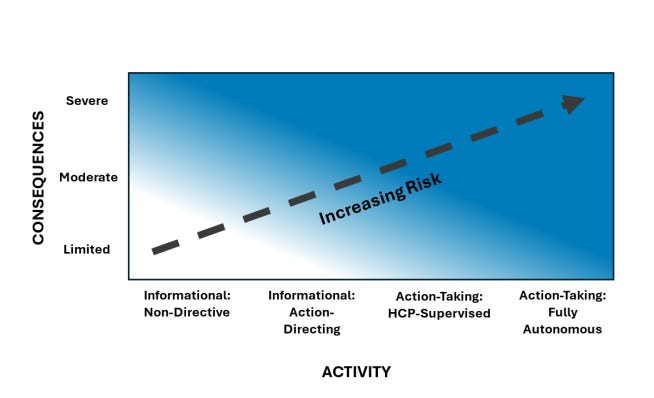
An important food for thought for businesses building AI-driven medtech devices — about risk management. A lot of health apps give someone specific advice and then add "talk to your doctor" underneath, on the assumption that the disclaimer keeps them in the safe, informational category. The FDA is signalling that it probably does not… What does is what the output actually tells the person to do.
⚡ This issue is brought to you by SYDRA

The Brief
💰 Follow the Money
In a historical milestone, Moderna and Merck's intismeran, an mRNA vaccine built individually for each patient using data of their own tumour's mutations, kept melanoma from returning for longer when added to Keytruda, in a Phase 3 of about 1,100 people whose tumours had been surgically removed. It's the first randomised Phase 3 win for a personalised cancer vaccine, though the actual numbers come later at a conference, and each dose still takes months to manufacture. Anyway, Moderna’s stock jumped 177% on the news, its biggest one-day move ever, with Merck also gaining substantial upward movement.
Network Bio, a biobank-focused biotech startup, launched out of stealth with $50M and what it calls the world’s largest patient-tissue training dataset — 500,000+ patients with paired tissue, blood and longitudinal outcomes from Mass General Brigham, Penn, Duke and CU Anschutz on a common data model. Investors include Section 32, Thiel Bio, Founders Fund and Breyer Capital, which led the company’s first institutional round in 2022.
Interestingly, Network Bio and NVIDIA are also building what they describe as the first foundation model trained on cell-free RNA, using Parabricks and BioNeMo Recipes. The company also disclosed a $30M+ co-development and licensing agreement with a Fortune 100 healthcare company to identify and interpret novel disease signatures using Network’s proprietary AI architecture.
Harell Data, founded by Adaptive Biotechnologies co-founder Harlan Robins, raised $15M from Fuse and Cercano Management to let data owners host proprietary training sets and take a cut of the compute revenue from models trained on them, rather than waiting on downstream royalties.
Why it matters: it prices scientific data as a rentable asset instead of an equity bet. Early datasets come from A-Alpha Bio and Adaptive.
Faro, an AI startup working on clinical trials, raised $37M from Merck's venture fund and S32. CEO Scott Chetham says the startups chasing faster trial documents "just made tiny bits a little bit faster."
🤝 Deals & Alliances
Eli Lilly’s TuneLab models are now in Benchling. AbLab predicts antibody developability (thermal stability, aggregation, viscosity, solubility, etc) from heavy and light chain sequences. ChemLab returns ADME/Tox predictions from a SMILES string.
The catch: access is reciprocal. Participating biotechs contribute their own assay data through TuneLab’s federated learning platform, which never exposes the raw data, and admins install the models from Benchling’s Model Hub registry.
NOETIK hit the first payment milestone in its five-year GSK deal by getting its OCTO-VC cancer foundation models running inside GSK's own systems, which matters mainly because GSK is paying subscription-style fees to rent the models rather than buying drug candidates, and that arrangement is now producing money.
🔬 Science to Watch
Claude ran a 48-hour autonomous protein design campaign and published the prompt. Anthropic reports de novo binders against 14 of 15 targets — 1,320 designs, 354 of which bound in wet-lab testing at Adaptyv Bio and Twist Bioscience, with hit rates of 22.6–26.7% across the multi-target run and 35% in a single-target 24-hour campaign, against a stated field baseline of 10–15%.
The caveat, per Endpoints News, noted by Andrew Dunn: Claude generated nothing much itself, it orchestrated open-source tools (PXDesign, RFdiffusion, BoltzGen) and reasoned over the results, and hit rate moves with target difficulty. Maltose-binding protein defeated all 90 designs against it. Designs, raw data, a 29-page technical report and the full ~16,000-word prompt are public.
Insilico Medicine sketched out what an ageing virtual cell would look like. Most virtual cell models are trained on cells caught at a single moment, so they can tell you what a cell looks like but not how it got there or where it's going. Insilico wants to go further, making age the thing the model is operating on. Instead of one big gen network, they plan on using a group of AI agents that each handle a different level — molecules, cells, tissues, organs, the whole organism, communicating between each other.
The idea is you could ask what happens if you, say, knock out a gene, and get the answer accounting for time and space. I think it is more of a concept for now, as I did not find specific data or paper yet. They say more thinking is coming at Aging Research and Drug Discovery Meeting in Boston soon.
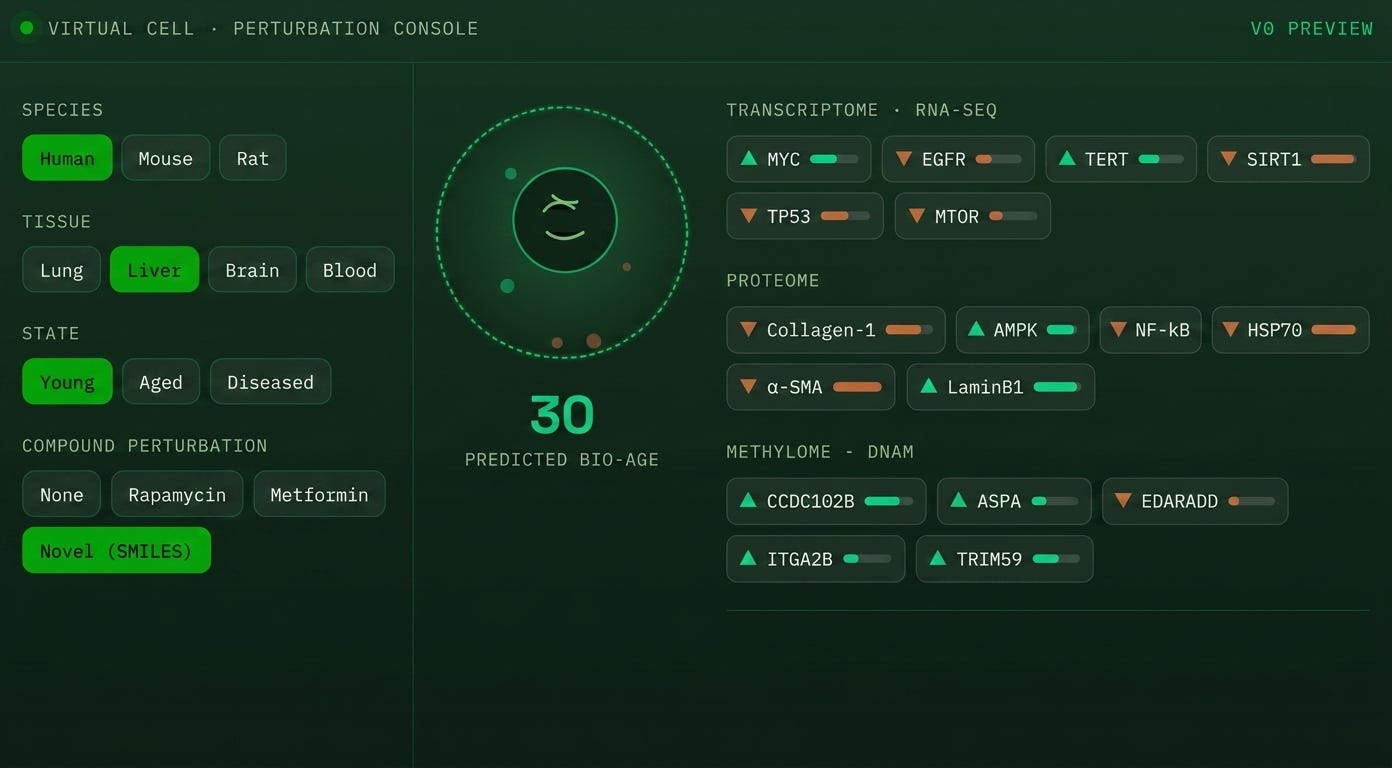
In a new article in Cell, authors published fifteen grand challenges for generative AI in cell biology, sorted into four categories: molecular interactions, molecular functions, cellular and systems function, and translation.
Why it matters: the authors argue current systems are benchmarked on retrospective statistical tasks rather than decisions, and call for CASP-style held-out evaluation.
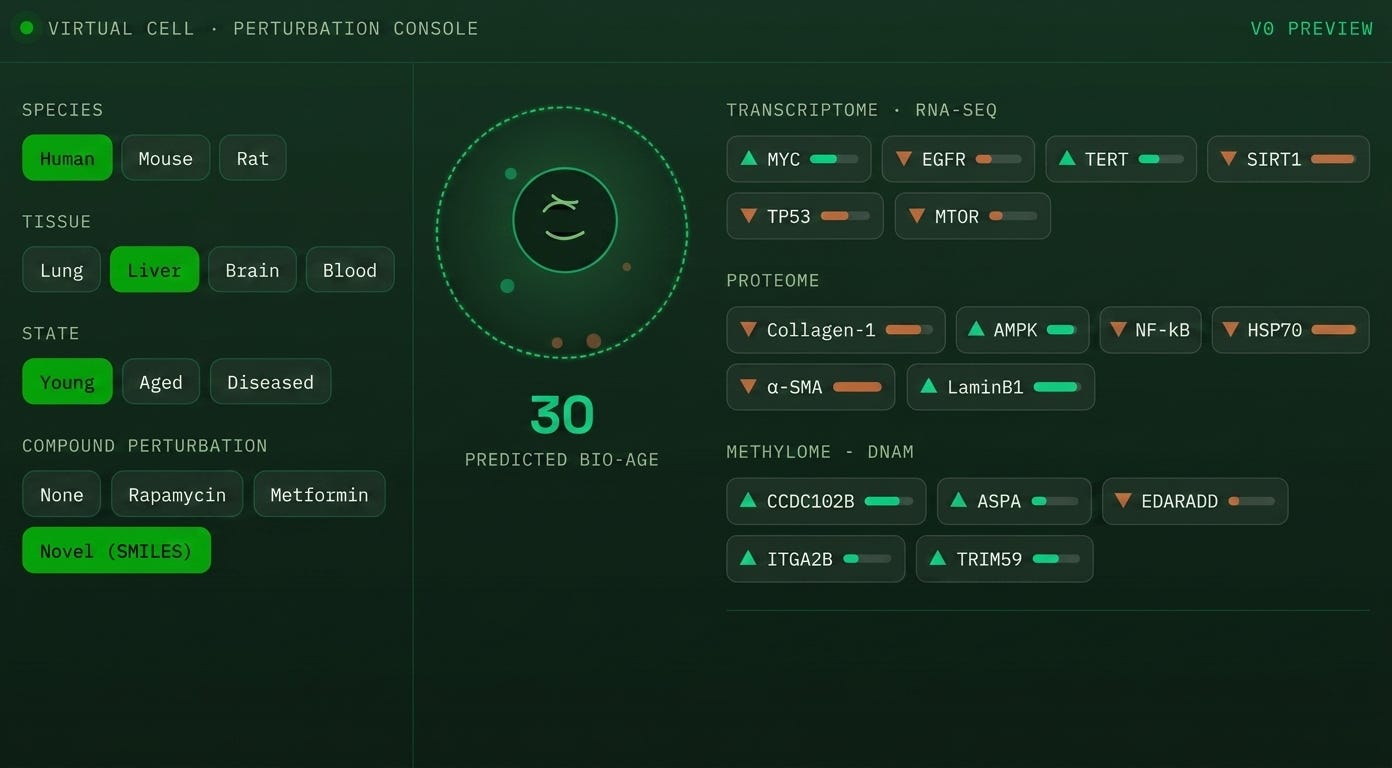
A Nature Reviews Neurology perspective maps what happens after a clinical model works: outcome benefit, workflow fit, reimbursement and drift, arguing deployment is not the end of model development but another stage of evaluation.
📋 From the Regulators
The FDA approved Revolution Medicines' daraxonrasib for previously treated metastatic pancreatic cancer — the first drug ever cleared that hits RAS broadly, the cancer gene that defeated the industry for forty years and drives nearly every pancreatic tumour. It doubled median survival to 13.2 months against 6.7 on chemotherapy in the Phase 3 RASolute 302 trial, and the FDA cleared it six and a half months ahead of schedule.
⚡In partnership with SYDRA
Most AI drug-discovery companies begin with a target and use algorithms to optimize molecules around an assumption. SYDRA reverses the logic.
Our proprietary AI selects and generates novel chemistry; whole-organism lifespan assays reveal which molecules actually affect aging biology; and only the phenotype-proven winners advance into aged-mouse studies, human-cell target deconvolution and disease positioning.
Starting from six million molecules, we identified five significant lifespan hits, advanced two lead programs into late-life mouse pilots, and created a new generative chemistry cohort now entering synthesis. We don’t use AI to decorate a target hypothesis. We let living biology decide which AI discoveries deserve to become medicines.SYDRA is now raising a CHF 2.6 million pre-seed round to accelerate lead programs toward pharma partnering.
A Thing To Know This Week
Beyond the Code: How DNA Nanotechnology is Moving from Molecular Origami to Programmable Biotech Platforms
In a new article published on BiopharmaTrend, Louise von Stechow and Marco Lolaico make the case that DNA is worth treating not only as a carrier of genetic information but as a construction material, one whose predictable base pairing lets researchers fold structures that place proteins, ligands or fluorophores exactly where they want them, and even build devices that switch shape or release cargo on cue.
In the article, Louise and Marco walk through where that has actually reached the market, which so far is mostly research tools and diagnostics:
- GATTAquant already sells DNA origami calibration standards for microscopy,
- Amplifold raised €5 million to make rapid tests roughly a hundred times more sensitive without changing the familiar lateral-flow format,
- Nanogami and MediQuant are building biochips and point-of-care drug monitoring, respectively… and so on.
Therapeutics are further back:
Plectonic's logic-gated T-cell engagers, DoriNano's cancer vaccine now working with Memorial Sloan Kettering and Daiichi Sankyo, DNA Nanobots' non-viral gene delivery — all still preclinical.
The authors are clear-eyed about why: the structures are expensive to make, they fall apart in the body, and nobody has settled how to prove batch-to-batch consistency.
Cost is improving fast, though (a 2026 study got to about $6 per milligram in the lab), but they argue cheaper DNA alone won't do it, and that the field needs standardized manufacturing, better stabilization, quantitative quality control, and regulators willing to say which structural attributes actually matter.
Read the article here.
Strategic Signals…
Bart De Witte, co-founder and CEO of Isaree, argues that Apple's new M5 Ultra chip, 512GB of unified memory under a desk, kills the assumption that hospital AI has to mean shipping patient data to someone else's data centre, because a frontier-scale medical model now fits in local memory. His company is building for that world: an open platform where clinicians build their own agents, running on-device or on-prem, with GDPR compliance built into the architecture (especially relevant for EU-based facilities).
That was last week, and have a great one ahead!
Forward this to a colleague who should be tracking this space,
Cheers!
— Andrii and WTMB Team!
Read also:
Could Anthropic Disrupt the Techbio Companies Built for Pharma/Biotech? (Also: The Numbers Behind China’s Biopharma Ascent)
Is the Future of AI Drug Discovery Hybrid?
Three Big Ideas in Aging Research That Could Shift the Therapeutic Landscape
Cancer as a Data Problem: What AI Is Doing in Oncology
Good issue, and the FDA section is the most useful summary of that discussion paper I've seen.
Your point about the disclaimer is the sharpest thing here. That "talk to your doctor" underneath specific advice probably doesn't buy an app the informational classification, because what counts is what the output tells the person to do. What's interesting is that three separate items in this issue are making the same argument from different directions. The FDA says you can't pre-specify every correct output, so you evaluate against a clinician panel and keep monitoring. The Cell piece says current benchmarks test retrospective statistical tasks rather than decisions. The Nature Reviews Neurology perspective says deployment is another stage of evaluation rather than the end of one.
All three are moving evaluation from output-referenced to decision-referenced. Which is exactly why the disclaimer fails: if the unit of assessment is the decision the output produces, a sentence appended after it can't reclassify anything.