Is the Future of AI Drug Discovery Hybrid?
Some field notes from the cutting edge of modern bioinformatics (CoFold Summit and Free Energy Workshop, both held recently in Barcelona, Spain). ALSO: several companies to watch in techbio space.
Everyone is talking about frontier AI models and agents. But the most interesting conversations I had in Barcelona earlier this month during two cutting-edge bioinformatics events pointed in a different direction.
I attended two events back-to-back: the Alchemistry Workshop on Free Energy Methods (May 4–6) and the inaugural CoFold Summit (May 6).
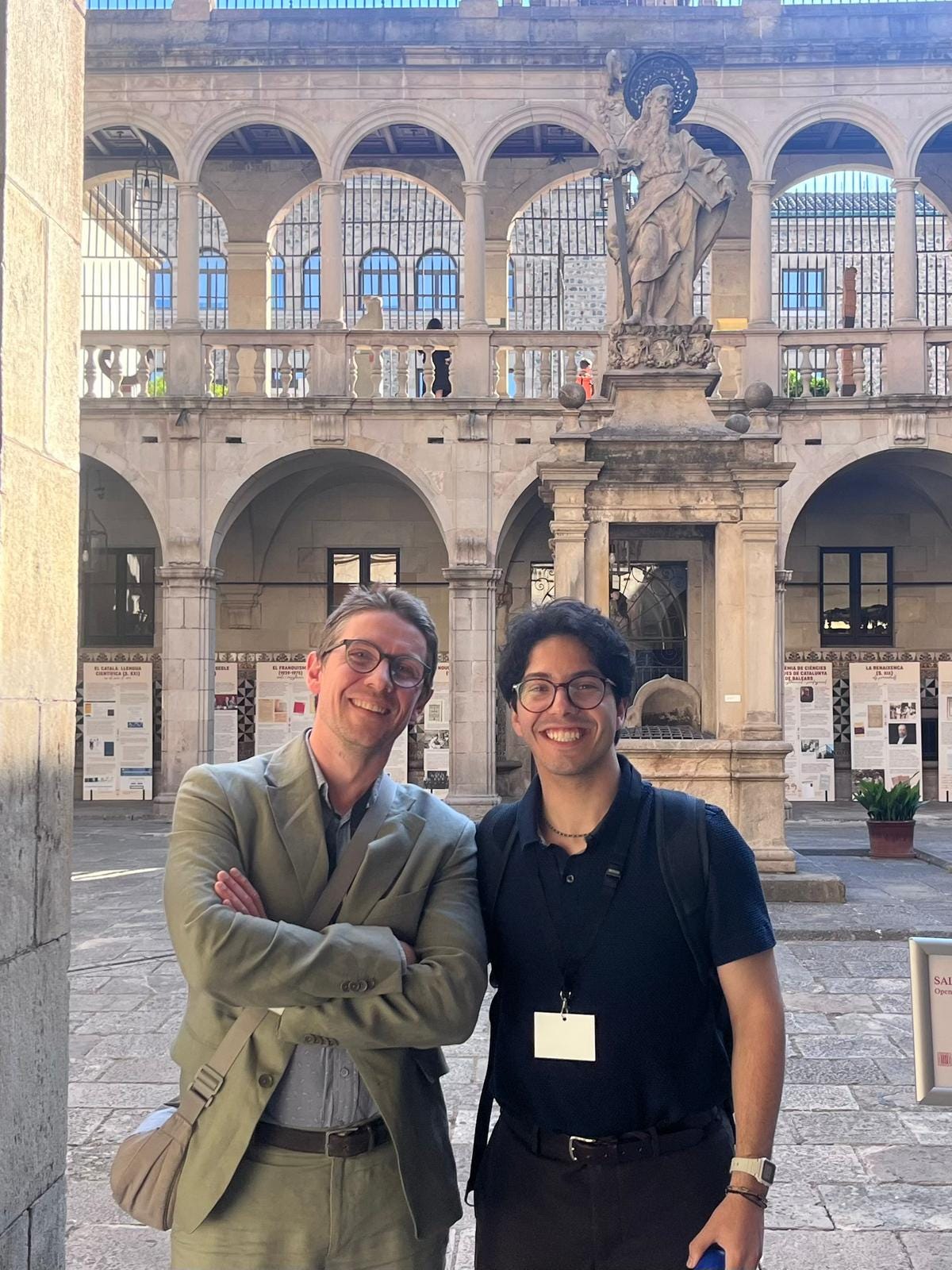
The first is the established annual conference for physics-based drug design, with participation and sponsorships from companies like Schrödinger, AstraZeneca, Cresset, OpenBioSim, etc. The second brought together the teams building deep learning co-folding models — Isomorphic Labs, Boltz, OpenFold, RoseTTAFold, SandboxAQ, and others. Same city, same week, overlapping audiences.
Frontier AI models alone won’t get you far in biology. We need to invest in physics-grounded tools and methods.
Anyway, speaking about free energy perturbation methods, they have become the industrial workhorse for binding affinity prediction, and GPU acceleration has moved them from supercomputers to everyday pharma workflows. But FEP needs good starting structures, and it struggles with structurally diverse compounds coming out of generative AI pipelines. On the co-folding side, models like Boltz-1x are making real progress on the chemical validity of predicted poses. But they still default to well-represented binding sites from training data and can’t reliably score what they generate. Allosteric pockets, novel targets, anything underrepresented, still a major challenge.
The pattern kept coming up in different sessions and hallway conversations. Co-folding generates structural hypotheses from sequence alone. Physics-based methods provide rigorous validation. Neither works well in isolation.
The companies doing interesting work at this interface — SandboxAQ, Genesis Molecular AI, Iambic, Schordinger, etc., seem to get this. The real progress is hybrid: learning-based generation feeding into physics-based refinement.
I think the current hype around general-purpose AI agents obscures something important about the pharma and biotech realm of AI progress. In drug discovery, binding is fundamentally a physics problem. Models trained on data can approximate physics, but they can’t replace it, not yet. The teams investing in both sides are the ones to watch.
Now, since conferences were specifically focused on FEP and co-folding methods, I decided to share a couple of trends in those areas here:
Observations about free energy perturbation methods
FEP has become the workhorse for binding prediction. Free energy perturbation calculations can now reliably predict how well a molecule binds to a protein target. What used to require supercomputers and deep specialist knowledge now runs on a few GPUs, thanks to better hardware and better classical force field parameterization.
The shift is from artisanal to industrial. Drug discovery moved from hand-designed molecules to combinatorial libraries in the late ‘90s, and FEP is following the same trajectory, from carefully hand-tweaked individual calculations to routine bulk triaging of large compound sets before synthesis.
The binding problem is increasingly solved; everything else is not. FEP handles potency prediction relatively well, but druglikeness, metabolism, PK, toxicity, and crystal polymorphs remain poorly amenable to computation. So FEP doesn’t replace medicinal chemistry judgment yet; it removes one major bottleneck while the others persist.
The generative chemistry + FEP synergy is the frontier, but it’s hard. AI-generated molecules tend to be structurally diverse (not congeneric series), which means you need absolute binding free energy (ABFE) calculations rather than relative ones. ABFE is more expensive and less accurate. That’s the current bottleneck for combining generative AI with physics-based validation at scale.
Ease of use matters for adoption. The article argues (via Cresset’s Flare product) that automation, error-checking, and cloud access are what turn a specialist method into an everyday tool across organizations.
Here is what Dmitry Lupyan, Research Leader at Schrodinger, got to say about the current state of FEP:
I've been attending these workshops since 2012, and for the first time, it was obvious that pharma desperately wants to scale up FEP calculations, but they cannot. The reason is either prohibitive licensing costs or computational resources. Everyone seemed to want to go from screening 100s of calculations/year to 100K; hence, there were several talks on how to speed up the calculations by trying various tricks. If anything, this is a nice problem to have as the methodology is now becoming an industry standard, and the remaining task is just engineering, with more predictable outcomes than basic R&D.
Observations about co-folding methods
Orthosteric binding works reasonably well; allosteric does not, yet. Co-folding methods reliably place ligands in the main (orthosteric) binding site but consistently fail to find allosteric pockets, instead defaulting to the orthosteric site. This is a training data bias problem because orthosteric sites arguably dominate the protein data bank (PDB).
Boltz-1x is the chemical validity winner. Only 1.5% of its predicted ligands had any PoseBusters issue (default settings), versus 56% for Boltz-1, 93% for NeuralPLexer, and 85% for RoseTTAFold. Under stricter criteria, everything degrades significantly.
Prevalence in training data correlates with success. When allosteric sites are well-represented in the PDB (like GCK), predictions improve. But it’s not the whole story — some well-represented allosteric sites still fail.
The dual-ligand trick helps but does not solve the problem. Submitting two copies of the allosteric ligand improved sampling (50% placed correctly), but you still can’t reliably distinguish the correct pose from incorrect ones without external scoring.
The core tension with co-folding methods: These methods show promise as potential replacements for docking and even FEP, but they currently lack physics-based scoring, produce ensembles of unknown quality, and need significant post-processing before they’re useful for prospective drug design.
📢 Announcement: I’ll be at HLTH Europe in Amsterdam this June (15-18) as an invited journalist/science writer. It is arguably Europe’s largest healthcare tech event, with 5,000+ attendees, one in three at the C-suite level.
I’ll be covering what’s actually being said in the hallways, not just on the stages. If you’re attending, let me know, happy to connect in person! And if there’s a specific topic or company you would want me to dig into while I’m there, drop it below.
Company Picks
During the event, I talked to several company reps and founders, including , and so I decided to summarize some of the interesting companies in this space:
SandboxAQ
It is an enterprise AI company spun out of Alphabet in 2022, currently valued at $5.75B after raising ~$950M. Their drug discovery division, AQBioSim, combines generative AI with physics-based molecular simulation — what the company calls Large Quantitative Models (LQMs).
The key technical claim is their proprietary Absolute Free Energy Perturbation method (AQ-FEP), which, according to SandboxAQ predicts binding affinities without requiring reference compounds, making it applicable to structurally diverse libraries rather than just congeneric series.
The company says it can profile over 20,000 ligands per day at scale using this approach. They report partnerships with AstraZeneca, Sanofi, and UCSF, among others.
Genesis Molecular AI
Founded in 2019 in California (originally as Genesis Therapeutics, rebranded to reflect the AI focus). The company's core platform is GEMS (Genesis Exploration of Molecular Space), which, according to Genesis, combines proprietary deep learning models with physics-based molecular simulation for small molecule drug design.
Their flagship model, Pearl, is a 3D diffusion foundation model for protein-ligand structure prediction that the company claims outperforms AlphaFold 3 on binding pose prediction, notably, trained using large-scale synthetic data generated from physics simulations, not just experimental PDB structures.
Genesis has raised over $300M from investors including a16z, NVIDIA, Fidelity, and BlackRock. They report active collaborations with Gilead, Eli Lilly, and Incyte — the Incyte partnership was recently expanded to cover at least five additional targets, with Incyte sharing proprietary experimental data to further train GEMS. Nate Gruver from Genesis presented at the CoFold Summit in Session 2 on predicting properties beyond structure.
Iambic Therapeutics
Founded in 2019, headquartered in San Diego. A clinical-stage company whose platform combines two main proprietary AI models: NeuralPLexer, a co-folding model for predicting protein-ligand complex structures directly from sequence, and Enchant, a multimodal transformer that according to the company predicts clinical and preclinical endpoints from small, noisy datasets. The company describes its approach as physics-informed — integrating physical principles into AI architectures to improve data efficiency and enable broader exploration of chemical space. Iambic claims to complete full design-make-test cycles on a weekly cadence through tight integration of AI-generated designs with automated high-throughput chemistry and biology. They report their lead oncology program went from program start to clinic in under 24 months. Partnerships include a multi-year collaboration with Takeda announced in early 2026 (potentially worth over $1.7B in milestone payments) and a technology collaboration with Revolution Medicines. Matt Wellborn from Iambic presented at the CoFold Summit
Nostrum Biodiscovery
Founded in 2015 in Barcelona as a joint spin-off of the Barcelona Supercomputing Center (BSC) and the Institute for Research in Biomedicine (IRB Barcelona), with participation from the University of Barcelona and ICREA. Co-founded by Victor Guallar, Modesto Orozco, and Robert Soliva.
The company's core technology is PELE (Protein Energy Landscape Exploration), a Monte Carlo-based molecular modeling algorithm for protein-ligand docking, binding site prediction, and protein surface exploration. Their commercial platform, NostrumSuite, integrates PELE with AI-driven molecular modeling for virtual screening, hit-to-lead optimization, and applications across small molecules, antibody design, targeted protein degradation, and nucleic acid therapeutics.
According to the company, their ALScreen platform combines AI and molecular modeling for virtual screening of both predefined and ultra-large compound libraries. Nostrum describes itself as bridging physics-based simulation and AI — notably, they are rooted in HPC and biophysical simulation rather than coming from the deep learning side.
Apheris
A Berlin-based company co-founded by Robin Röhm that provides federated computing infrastructure for drug discovery. The core premise is that pharma companies hold proprietary structural and molecular data they can't share due to IP constraints, but that data is exactly what co-folding and ADMET models need to improve.
Apheris claims to solve this by bringing computation to the data rather than moving data, enabling multiple organizations to collaboratively train and benchmark AI models without exposing proprietary datasets.
They provide the technology layer for the AI Structural Biology (AISB) Network, an industry-led collaboration that, according to the company, includes AbbVie, Astex, AstraZeneca, Boehringer Ingelheim, Bristol Myers Squibb, Genentech, Johnson & Johnson, Sanofi, and Takeda. One of the network's flagship projects is fine-tuning OpenFold3 on proprietary structural data from multiple pharma companies — without that data leaving each organization — in collaboration with Mohammed AlQuraishi's lab at Columbia.


