


We are writing with an important update about the Where Tech Meets Bio newsletter.
Where Tech Meets Bio, as well as BiopharmaTrend, are now published by WTMB Research & Media SL, a company based in Spain.
This follows the restructuring of our business. Our editorial commitment remains focused on covering the cutting-edge technological advances in pharma, biotech, and medtech industries, companies that drive those advances, and regular analysis of industry trends.
As part of this transition, we are updating our payment system. This means:
— If you are a free subscriber, no action is needed. Your subscription continues as normal.
— If you are a paid subscriber, your current subscription will be cancelled, and you will receive an automatic prorated refund for any unused portion of your subscription. We wish we could avoid it, but this is due to Substack's internal hard limitation to be able to transfer payment arrangements when the newsletter moves to another country.
We will notify you when the new payment system is live so you can resubscribe if you wish. We apologise for the inconvenience and deeply appreciate your support.
Importantly, the data controller for this newsletter is now WTMB Research & Media SL (CIF: B93869147), C/ Almirante Cadarso nº 26, 46005 Valencia, Spain. Please read our Privacy Policy to know your rights concerning your personal data.
You can unsubscribe at any time using the link at the bottom of this newsletter if you do not wish to receive future emails from us. However, we do hope you continue reading our work, because we are going to expand and deepen our analysis and coverage of the “tech+bio” frontiers.
Thank you for being part of our community!
In the meantime, keep reading this week’s highlights as we are gradually renewing our weekly cadence.
Cheers!
— Andrii and the Team of Where Tech Meets Bio newsletter, from sunny Spain🌴.
In this issue: a decade-in report card on AI drug discovery; frontier AI labs moving into the CRO and clinical-trial layer; agentic co-scientists landing inside pharma research organizations; what is happening in in vivo cell therapies; the FDA piloting a faster route into first-in-human trials, and other key signals.

After a decade of AI drug discovery, two of its vocal voices assess progress
Perhaps unusually for August, there is a lot of business and research activity in the artificial intelligence (AI) drug discovery space. Notably, within four days of each other, two respectable voices in the AI drug discovery space independently published two important pieces about the state of progress, where industry stands about all sorts of AI tools as of 2026, and where it may take us from here.
On August 3, insitro founder and celebrity in the field of artificial intelligence Daphne Koller published “Drug Discovery Has No Magic Wands.” She splits development broadly into three stages:
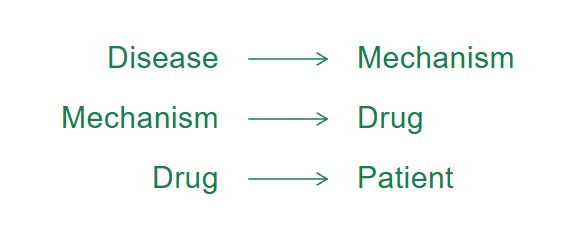
… and argues AI effort has concentrated overwhelmingly on the middle one, molecular design, while more than 90% of clinical failures come from picking the wrong mechanism. Even total success on the AI-addressable portion, she notes, touches only about half a development timeline; the cell atlases needed to attack stage one are “orders of magnitude too small.”
On August 7, Dr. Andreas Bender, Professor for Machine Learning in Medicine at Khalifa University, and a large co-author group published “Artificial intelligence in drug discovery — what it is, where we stand and the path forward” in Nature Reviews Drug Discovery.
Its verdict on a decade of work: clinically relevant impact has been “disappointingly limited,” caused by too little focus on clinical translation, the context-dependent nature of real biological data, and problem definitions too vague for the decisions the models are meant to inform. The prescription is a shift from “technology push” to “science pull,” and benchmarks that measure improved decision-making rather than model performance.
Neither piece cites the other, the convergence seems to be independent, which likely signals a growing industry consensus about the current state of AI in drug research.
⚡ This issue is brought to you by SYDRA
The Brief
💰 Follow the Money
🔹Dash Bio raised a $30M Series A led by Oak HC/FT for its robotics-run bioanalysis lab — preclinical assays back in days, not months.
🔹Pathos AI in-licensed two oncology assets in one day for a reported ~$2.2B — a TROP2/HER3 bispecific ADC from Alphamab and an ERα PROTAC from AstraZeneca.
🔹Bruker took a majority stake in organ-on-a-chip maker MIMETAS (terms undisclosed). Why it matters: positions Bruker in the New Approach Methodologies push to replace animal testing.
🔹Anthropic opened rare disease research grants — up to $50,000 in Claude credits over six months, two tracks, applications closed August 2.
🤝 Deals & Alliances
🔹Bristol Myers Squibb is deploying Schrödinger’s agentic AI co-scientist Bunsen across its research organization, plus the RetroSynth synthesis planner. Terms undisclosed.
🔹Genentech exercised its first option on a Recursion-discovered neuroscience target, moving it into joint small-molecule discovery. The numbers: first target out of a collaboration that has paid Recursion $216M to date, with up to 40 possible programs. — link
🔹ICON, a top-five CRO, signed a multi-year deal to embed Claude across the clinical trial lifecycle. Backstory: caps a year of Anthropic life-science moves — Claude for Life Sciences, the ~$400M Coefficient Bio buy, Claude Science, and hiring AlphaFold’s John Jumper.
🔹J&J paid $785M for an option to acquire in vivo CAR-T player Sail Biomedicines for a further $2.58B. Backstory: the fifth major in vivo CAR-T deal since Lilly’s $7B Kelonia buy in April thinned the field of outright targets.
🔹Merck KGaA adopted Evinova‘s AI-native clinical development platform — AstraZeneca’s in-house health-tech business selling to a competitor.
🔹Pharma is pooling its structural data. C&EN on the Federated OpenFold3 Initiative, where AbbVie, J&J, BMS, Takeda and Astex train a shared open model without exposing IP.
🔬 Science to Watch
🔹A CRISPR enzyme that kills cancer cells by shredding their own DNA. Doudna’s group published Cas12a2 in Nature: triggered by a mutant RNA transcript, it destroys the host cell’s chromatin, killing p53-mutant cells while sparing healthy ones. Preclinical.
🔹An AI biologist called XunZi flagged CHK2 as a Parkinson’s target; inhibiting it rescued dopaminergic neuron loss and motor deficits in mice. Nature Biomedical Engineering, Aug 4.
🔹Open-weights models that read chemistry out of patents. Edison Scientific’s MarkushGlyph parses Markush structures at 58–64% accuracy; single-structure recognition hits 93.8%. What it is: Markush diagrams are how one patent claims millions of compounds.
🔹Clinical AI’s dangerous failure is omission, not fabrication. The NOHARM benchmark found errors of omission account for >80% of severe errors across 20 LLMs and 4 RAG clinical tools. Preprint.
🔹Recursion says protocol simulation against real patient data expanded trial eligibility 10–40%, with enrollment 30–60% above historical projections. Vendor-reported.
🔹Insilico launched a benchmark for AI drug discovery models — 300+ evaluations across two suites, live since July 30. No leaderboard scores published yet.
🔹~50 authors proposed an L0–L5 autonomy ladder for laboratories, arguing self-driving labs need a shared “world model” layer. Leskovec, Uhler, Ioannidis and Shah among the signatories.
📋 From the Regulators
🔹FDA is piloting a faster route into first-in-human trials. The Expedited IND Pilot would let sponsors use pre-vetted research institutions and file INDs on a rolling basis; the agency estimates clarified Phase 1 CMC expectations alone could save 6–12 months.
🔹A companion draft guidance shifts first-in-human dose selection toward QSP modelling and away from animal toxicology.
⚡In partnership with SYDRA
Most AI drug-discovery companies begin with a target and use algorithms to optimize molecules around an assumption. SYDRA reverses the logic.
Our proprietary AI selects and generates novel chemistry; whole-organism lifespan assays reveal which molecules actually affect aging biology; and only the phenotype-proven winners advance into aged-mouse studies, human-cell target deconvolution and disease positioning.
Starting from six million molecules, we identified five significant lifespan hits, advanced two lead programs into late-life mouse pilots, and created a new generative chemistry cohort now entering synthesis. We don’t use AI to decorate a target hypothesis. We let living biology decide which AI discoveries deserve to become medicines.SYDRA is now raising a CHF 2.6 million pre-seed round to accelerate lead programs toward pharma partnering.
A Thing To Know This Week
In vivo CAR-T, and why everyone is buying it
Conventional CAR-T extracts a patient’s T cells, engineers them in a facility to recognise a cancer target, and infuses them back. It works, at several hundred thousand dollars per patient, over weeks, at specialist centres only.
In contrast, in vivo CAR-T does the engineering inside the body: inject a lipid nanoparticle or targeted viral vector that reprograms T cells where they already live. No extraction and no manufacturing slot, a body becomes, basically, its own bioreactor for the therapy. If it works, a cell therapy becomes almost as simple as a regular injection.
That “if” is what eighteen months of dealmaking has been pricing on the level of strategic M&As.
AstraZeneca, AbbVie and Gilead each bought a platform in 2025; Lilly bought two in early 2026, for up to $7B in total. Most of these assets are preclinical — pharma is arguably buying delivery technology on the bet that the biology is proven and only the logistics are mostly unsolved.
Interestingly, Johnson & Johnson appears to be more cautious. J&J’s $3.5 billion deal with Sail Biomedicines serves as the textbook definition of an "option-first" structural hedge. Rather than acquiring an in vivo company outright at a massive premium like others, J&J structured a massive option agreement that secures early platform access while shifting early clinical risk entirely onto the partner.
Strategic Signals…
🔗 DeepMind dismantled the AlphaFold team — and it matters less than the headline suggests.
🔗 Ramy Farid called AI in drug discovery “nonsense” in 2024. In July he shipped an AI co-scientist and said he couldn’t be more pleased to be wrong about AI in the past.
🔗 “Forward deployed scientist” is becoming a real job title — Chai, Phylo, Lila and Periodic Labs are all hiring it.
🔗 China's share of first drug launches rose from 3.3% to 28.7% between 2004 and 2024 while Europe's fell from 26.7% to 8.5%, per a new analysis. US is still leading the pack but declined from 45.9% to 37.8%.
That was last week, and have a great one ahead!
Forward this to a colleague who should be tracking this space,
Cheers!
— Andrii
Read also:
Could Anthropic Disrupt the Techbio Companies Built for Pharma/Biotech? (Also: The Numbers Behind China’s Biopharma Ascent)
Is the Future of AI Drug Discovery Hybrid?
Three Big Ideas in Aging Research That Could Shift the Therapeutic Landscape
Cancer as a Data Problem: What AI Is Doing in Oncology
David Shaywitz in the TMR wrote a nice summary of the two pieces mentioned at the top of this report.
Really interesting roundup, Andrii. What stands out is how AI is moving beyond individual discovery tools into the wider R&D ecosystem-from co-scientists and CRO workflows to clinical development.
At the same time, the reminder that biology and clinical translation-not the technology itself-remain the real test is especially important.