Weekly Tech+Bio #87: TechBio 3.0 Is Closing the Loop. Is "Prompt to Drug" Next?
ALSO: ByteDance spins out Anew Labs on a $290M round; Lilly's TuneLab ships a nanobody developability model built on BigHat data; a partial reprogramming therapy early in glaucoma, and more...
Welcome to the Where Tech Meets Bio newsletter, where we explore companies, technologies, and scientific breakthroughs shaping the biopharma industry's future!
If this newsletter is in your inbox, it’s because you subscribed, or someone thought you might enjoy it. In either case, you can subscribe directly by clicking this button:
Thanks for reading Where Tech Meets Bio! Subscribe for free to receive new posts and support my work.
In this issue: a new review names "TechBio 3.0" just as Alex Zhavoronkov says prompt-to-drug may be here soon for low-to-moderate novelty — Schrödinger's Bunsen now launches ~80% of the company's own modeling jobs — ByteDance spins out Anew Labs at a RMB 10B valuation — Tempus becomes part of the manufacturing chain for Merck and Moderna's personalized cancer vaccine — a scaled-back version of a Nobel-winning reprogramming trick shows first signs in human eyes, and more…
Main Story
A couple of days ago, Alex Zhavoronkov, founder and CEO of Insilico Medicine, posted that he thinks we are approaching a “pharmaceutical singularity”, and that “prompt to drug is now possible in low-moderate novelty space.” The real moat now, he added, is operational efficiency and the ability to deliver.
It is a strong statement, I’ll come back to it.
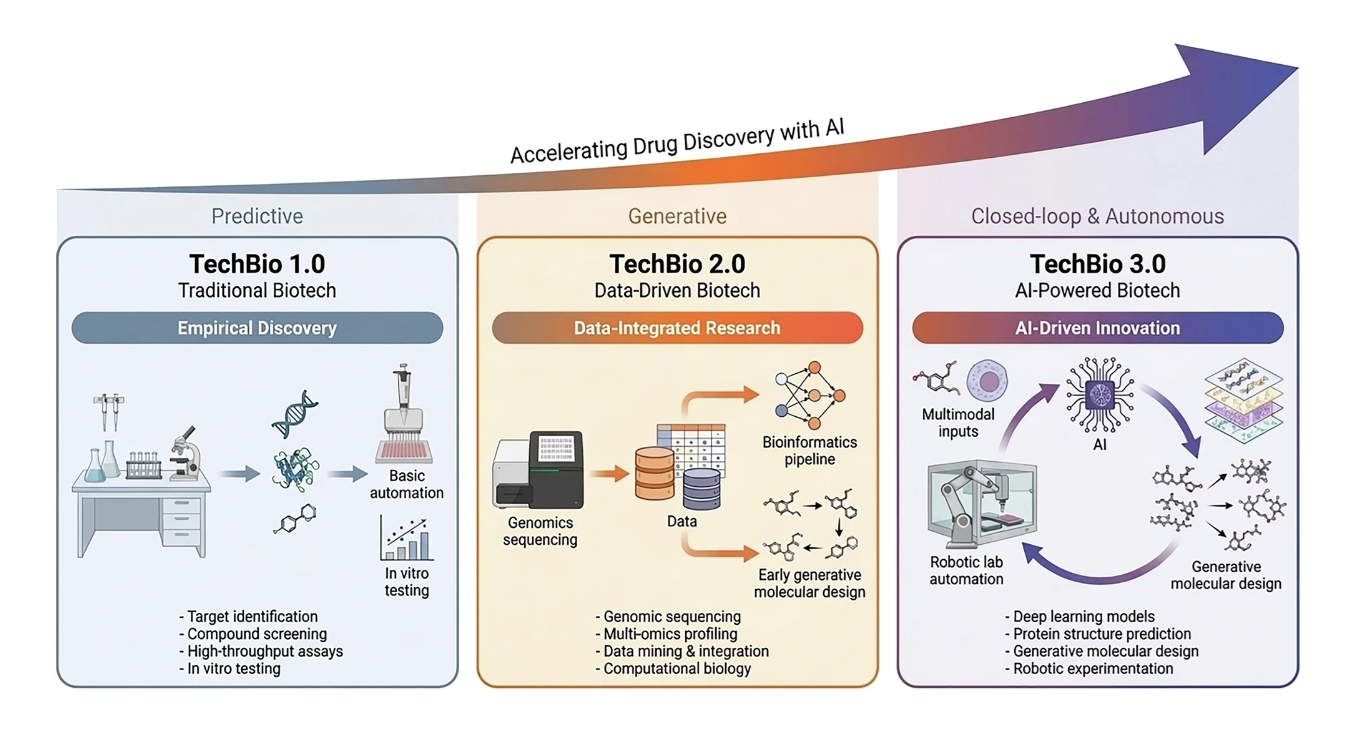
Now, last week, Krish Ramadurai and Abhirup Banerjee published a review in npj Drug Discovery that gives the underlying trend a name: TechBio 3.0. They split the last decade into three generations:
TechBio 1.0 (≈2015–2019), prediction: ML models ranking and filtering compounds inside conventional pipelines.
TechBio 2.0 (≈2020–2023), acceleration: generative models and end-to-end platforms, with Insilico’s IPF program going from target to preclinical candidate in about 18 months versus the usual 3–5 years.
TechBio 3.0, the closed loop: multimodal models, generative design with toxicity and PK constraints built into the objective rather than filtered afterwards, and automated experiments feeding structured data straight back into the models.
The schematic illustrates how recent generations of artificial intelligence (AI) drug discovery have evolved from predictive AI models that estimated properties (TechBio 1.0), to accelerating discovery workflows through generative-design molecule creation and target discovery (TechBio 2.0), toward closing the loop with multimodal and laboratory-integrated discovery platforms that couple prediction and generation with experimental feedback (TechBio 3.0). The large arrow represents the gradual adoption of AI into the drug-discovery workflow. Icons within each panel highlight the representative capabilities of that generation: simple automation and in vitro assays for TechBio 1.0, bioinformatics pipelines and genomic sequencing for TechBio 2.0, and multimodal data inputs, generative molecular design, and robotic lab automation for TechBio 3.0. Image credit: Ramadurai, K., Banerjee, A. TechBio 3.0 closes the drug discovery loop with multimodal AI and generative chemistry. npj Drug Discov.3, 42 (2026). https://doi.org/10.1038/s44386-026-00078-x, CC BY 4.0
The authors are fairly sober about the evidence. As of mid-2026, no AI-designed small molecule has FDA marketing approval. Rentosertib remains the most advanced proof point, with Phase IIa data in 71 IPF patients (a mean +98.4 mL in forced vital capacity at the top dose) and Phase III expected in the second half of 2026. They also cite Iambic, which filed for its Nasdaq IPO a few weeks ago, as a working example of weekly design-make-test cycles.
It is interesting how much of the news lately is about the loop rather than the models:
Lilly’s TuneLab released a nanobody developability model trained on 2,500+ VHHs that BigHat characterized in six one-week design rounds.
AstraZeneca and Carterra are co-building hardware and software to produce standardized binding data for lab-in-the-loop biologics discovery.
PacBio and TychoBio are sequencing full-length transcriptomes from 10,000+ samples to learn how antisense oligonucleotides behave across the transcriptome.
None of these is a model launch, but rather they are about producing data a model can trust (details in The Brief below).
The execution layer is moving too. Over the weekend, I published my interview with Robert Abel, CSO of Schrödinger, about Bunsen, the company’s agentic co-scientist. One number is especially telling: roughly 80% of the computational modeling jobs on Schrödinger’s own HPC (e.g. free energy calculations, molecular dynamics, quantum calculations, etc.) are now run by Bunsen. Importantly, the LLM is not predicting molecular properties itself. It chooses among validated physics methods and runs them, after a scientist has reviewed the work plan.
That brings me back to Alex’s qualifier. Abel makes a related point from the other side: ML accuracy generally worsens the further you move from the training data, and real discovery often happens exactly there — novel scaffolds, new resistance mutations, targets with few known ligands. His answer is physics as a data generator. A typical lead-optimization project might synthesize fewer than 1,000 designed molecules in a year, while atomistic simulations can produce several thousand data points in an evening.
So “prompt to drug in low-to-moderate novelty space” and “closed loops that work where data exists” may be describing the same frontier. The open question is high novelty, i.e., first-in-class targets, new modalities, where the loop has the least data to close on. The npj authors list it among the unresolved problems: predictors need applicability-domain checks before molecules go to synthesis. The authors are warning that a model can give a precise-looking score for a molecule it effectively knows nothing about. Their fix is to keep the model’s confidence level attached to each prediction at every step, so a shaky guess is not used for the final choice.
All in all, TechBio 3.0 may turn out to be less about a smarter model and more about who owns the data factory and the execution layer.
In January, we argued that 2025 was the year neurotech started designing around use cases: speech restoration as a defined clinical endpoint, noninvasive BCIs scaling on large datasets, organoids turning into standardized tools. This week offers two small tests of that thesis.
Silicon Valley-based Bridge Neurotech emerged from stealth with $13.5M from General Catalyst, reMind Capital, Sunflower Capital, Scott Sandell and others, to read brain activity through the skull with functional ultrasound imaging (fUSI) and AI decoding, with no surgery or implant. Founder Will Biederman designed the neural interface chip later used in Neuralink’s first implants during his Berkeley PhD, and co-founded Forest Neurotech. Bridge has licensed Butterfly Network’s Ultrasound-on-Chip through Butterfly Embedded and is enrolling its first research study in Redwood City.
What held: the pitch is a concrete one (a wearable, non-surgical interface, starting with a research study), not a general mind-reading device. What’s still open is what the company itself names as its two hurdles: getting reliable signal through the skull, and decoders that generalize across people. That’s the same cross-subject problem Tether Evo’s papers attacked in #85.
On brain delivery, WhiteLab Genomics’ AI-designed AAV capsids showed 50x higher brain DNA enrichment than AAV9 in IV-dosed mice (more in Follow the Money). It’s still mouse data, and larger-animal results will be the real check.
Big tech spins out AI pharma — ByteDance’s Anew Labs raised a $290M angel round at a reported ~$1.5B valuation. It has four preclinical assets, led by an oral IL-17A/F inhibitor.
mRNA made in cells — Sensible Biotechnologies raised $47M, including up to $20M in EU and Slovak grants, to scale cell-based mRNA manufacturing as an alternative to in vitro transcription.
AI-designed capsids — WhiteLab Genomics raised a $26M Series B led by AVP. Its AAV capsids reached the brain at 50x the level of AAV9 in mice, with no detectable liver signal.
Ultrasound BCI out of stealth — Bridge Neurotech raised $13.5M from General Catalyst and others to read brain activity through the skull with ultrasound and AI, no implant needed.
Watching immune cells kill — SpectaCell closed a seed round of EUR 6 million led by imec.xpand for a platform that tracks immunotherapy–target interactions in real time.
🤝 Deals & Alliances
Sequencing as a manufacturing step — Tempus expanded its deal with Moderna and Merck to run sample logistics and the sequencing used to design each patient’s personalized cancer vaccine, V940.
Data for Lilly’s models — Eli Lilly’s TuneLab released NanoLab, a nanobody developability model trained on 2,500+ VHHs characterized by BigHat Biosciences.
Lab data built for AI — Carterra and AstraZeneca will co-build hardware and software to produce standardized binding data for lab-in-the-loop biologics discovery.
Long-read RNA for model training — PacBio and TychoBio will sequence 10,000+ samples to train models predicting how antisense therapies for rare diseases act across the transcriptome.
Data first, agents next — Novo Nordisk runs ~900 TB of data on Snowflake for nearly 40,000 users and plans to turn its commercial data into an agentic system, per a Snowflake case study.
Neurotech, nine months on. In January we argued that 2025 was when neurotech started building devices around specific clinical jobs, with noninvasive BCIs advancing mainly through AI trained on large brain datasets. This week, Bridge Neurotech’s ultrasound BCI round fits that picture but still faces the hard part, decoders that work across people. Separately, on getting therapies into the brain, WhiteLab’s AI-designed capsids look promising but so far only in mice (both in Follow the Money).
Partial reprogramming reaches human eyes — Life Biosciences reported early Phase 1 data for its three-factor epigenetic reprogramming therapy in glaucoma: no treatment-related side effects so far, and visual-field gains in two of three patients at eight weeks. It is a conference presentation in three people, so very early.
The 2026 Nobel Prize in Medicine goes to optogenetics
On Oct 5, the Nobel Assembly at Karolinska Institutet awarded the 2026 Nobel Prize in Physiology or Medicine to Georg Nagel (University of Würzburg), Peter Hegemann (Humboldt University Berlin) and Karl Deisseroth (Stanford) for their work on light-gated ion channels and optogenetics. The three share 12 million Swedish kronor, about $1.2M.
The idea is that some green algae use light-sensitive proteins, called channelrhodopsins, to sense light and swim toward it. In the early 2000s, Nagel and Hegemann showed these proteins work as channels that open when light hits them, letting charged particles flow into the cell. In 2005, Deisseroth’s lab put one of them into mammalian neurons and showed that a flash of light could make those neurons fire on command.
That turned light into a switch for specific brain cells. Researchers can now genetically target one cell type, turn it on or off in milliseconds, and watch what changes in behavior. The Nobel committee noted that the method is now used in labs worldwide to study how the brain works.
Specifically, optogenetics became a standard tool for working out which circuits drive pain, addiction, movement or mood, which is the kind of evidence drug and neuromodulation programs build on. It has also reached patients: in 2021, a man blinded by retinitis pigmentosa partially regained sight after an optogenetic gene therapy, reported in Nature Medicine.
Strategic Signals…
According to Padraig McDonnell, President and CEO of Agilent, digital pathology is becoming the foundation for pathology data generation, analysis and application
Agilent agreed to acquire Proscia in an all-cash deal: $240M at closing plus up to $30M in performance milestones. Proscia’s vendor-agnostic software serves as a central operating layer for digital pathology. It connects scanners, lab information systems, image analysis apps, AI tools, people and data for more than 4,000 labs, hospitals and clinics and 16 of the top 20 pharma companies. It has trailing-twelve-month revenue above $18M and FDA 510(k) clearance for primary diagnosis.
Time will tell, but an instruments-and-reagents company paying roughly 13x trailing revenue (about 15x if the milestones are paid) for a software layer says where it thinks value is moving. Agilent already sells the stains, and it closed the $950M Biocare acquisition in June. What it didn’t own, despite distributing Proscia’s software since 2022, was the layer between the slide and the model. McDonnell says the deal establishes an Agilent platform connecting data generation with AI-based interpretation, from biomarker research through routine clinical use.
Members get the full access to every deep dive plus our complete archive. Become a member →
Loading...
That was last week, and have a great one ahead!
Forward this to a colleague who should be tracking this space,