


Welcome to the Where Tech Meets Bio newsletter, where we explore companies, technologies, and scientific breakthroughs shaping the biopharma industry's future!
If this newsletter is in your inbox, it’s because you subscribed, or someone thought you might enjoy it. In either case, you can subscribe directly by clicking this button:
In this issue: Isomorphic Labs raises $5B, well past Altos Labs' old record — Seawolf emerges with $100M and up to $1.2B from Sanofi, while Orakl raises $34M for virtual cancer patients — an open-source AI co-scientist in Nature Medicine publishes its own failures — Ginkgo tests Claude's phage enzyme on its cloud lab — a 26-study package maps the basal ganglia across 25.5 million cells, and more…
⚡This issue is presented by: SYDRA

We spoke with Dr. Alexander Dakhovnik, Co-founder and CEO of Zurich-based techbio startup SYDRA, about “hit-to-target” discovery for aging. SYDRA’s AI models select and generate candidate geroprotectors, the candidates are tested for lifespan effects in C. elegans and naturally aged mice, and only then does the team work back to targets and mechanisms. Two lead compounds dosed from 22 months of age showed 41.7% and 29.2% longer remaining median lifespan in groups of about 25–27 mice. The results are not statistically significant, and Alexander himself calls them exploratory.
We also discussed why aging is so hard to test in the clinic, how pharma is responding, and what comes next: omics, target ID, and SYDRA’s ongoing effort towards a pre-seed round.
Main Story
On November 17, Isomorphic Labs announced a $5 billion Series C, co-led by Greenoaks and Sequoia, with a16z joining as a new investor alongside Alphabet, Thrive Capital, MGX, GV, CapitalG, Temasek and the UK Sovereign AI Fund. As far as I can tell, this is the largest venture round ever raised by a techbio company, or by any biotech. The previous record was Altos Labs’ $3 billion in 2022, and the runner-up was Isomorphic’s own $2.1 billion Series B from earlier this year.
The pace is worth noting. The DeepMind spinout took its first outside money, $600 million, in March 2025. It now has about $7.7 billion in external funding, and Bloomberg reported talks at a valuation of about $50 billion (Isomorphic hasn’t disclosed one).
The use of funds shows where the company sees its bottleneck. Besides scaling IsoDDE, its drug design engine, the money goes to AI-first translational and clinical infrastructure, new foundational biology models and AI-led bioengineering. In other words, Isomorphic is building the parts of a drug company that come after the molecule.
That matters because, for all the capital, Isomorphic is still preclinical. The company says its oncology and immunology programs have shown positive preclinical results, and its partnered work with Lilly, Novartis and J&J continues (the 2024 Lilly and Novartis deals alone carry nearly $3 billion in potential milestones). But no candidate has entered the clinic yet.
The round also landed less than a week after Google DeepMind released AlphaGenome 2 (see Science to Watch), so Alphabet is backing both the general biology models and a drug company to use them.
So the question I’d ask is less “is $5B too much?” and more: what will the first clinical readouts need to show to justify a round of this size?
🚀 Introducing The Quantum Drug Discovery Tracker
“Quantum” in drug discovery means two different things. Most companies use quantum mechanics: they calculate how electrons behave in a drug and its target, on ordinary GPUs and supercomputers. A smaller group writes software for quantum computers, machines that may one day do those calculations far better but cannot yet beat classical methods on drug design problems.
Quantum-mechanical methods catch effects that standard molecular mechanics misses, such as charge transfer, covalent binding and metal chemistry, and they now feed machine-learning models with accurate training data. Quantum computing is the longer bet: if hardware scales, the hardest of these calculations become routine.
The Quantum Drug Discovery Tracker covers both directions.
The Brief
💰 Follow the Money
DNA medicines with pharma on the cap table — San Diego-based Seawolf Therapeutics emerged from stealth with a $100M Series A backed by Versant, Novartis Venture Fund and Eli Lilly. It also signed a multi-target Sanofi deal worth up to $1.2B in milestones.
Virtual cancer patients — Paris-based Orakl Oncology raised a $34M Series A co-led by Norrsken VC and Singular to expand into lung and gastric cancer. It claims 90% accuracy in predicting trial outcomes, and an April preprint on the model hasn’t been peer-reviewed yet.
🤝 Deals & Alliances
Valo Health and Montai Therapeutics are merging under the Valo name. Their wholly owned I&I pipeline is led by MTAI-1025, an oral NRF2 agonist in Phase 1 for ulcerative colitis, and no terms were disclosed.
🔬 Science to Watch
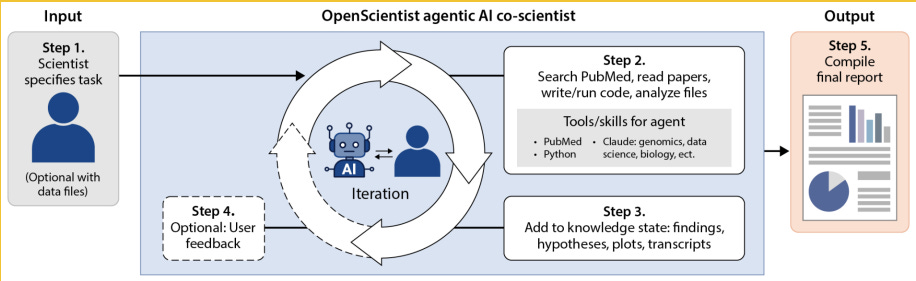
An AI co-scientist that shows its failures — Roberts, Reese et al. (Nature Medicine, Nov 16, 2026) present OpenScientist, an open-source agent that analyzes clinical data for about $10 a run, even fully offline. The authors report every attempted run, including failures and errors such as omitted multiple-testing corrections.
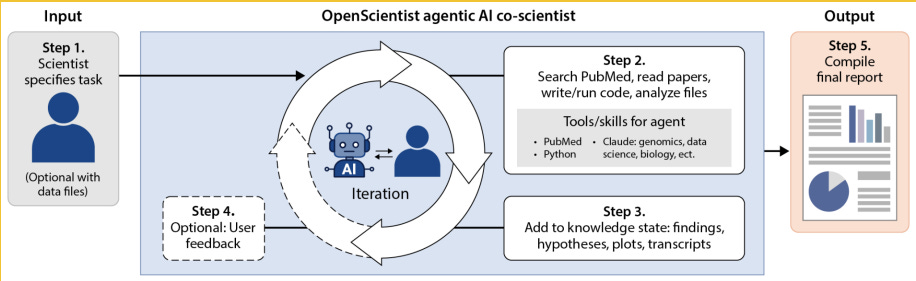
Roberts, K.F., Abrams, Z.B., Cappelletti, L. et al. An open agentic AI co-scientist for clinical and biomedical discovery. Nat Med (2026). https://doi.org/10.1038/s41591-026-04808-6. CC BY 4.0 Mapping the basal ganglia — 26 BRAIN Initiative studies in Cell Press journals (Nov 12, 2026), including Allen Institute work, profile 25.5 million cells from this deep-brain region tied to Parkinson’s and schizophrenia. Findings include a new neuron type linked to schizophrenia and bipolar risk.
AlphaGenome gets an upgrade — Google DeepMind released AlphaGenome 2, which predicts how DNA variants change gene activity in a chosen tissue or cell type. DeepMind says it finds about twice as many expression-altering variants as the previous best model.
Predicting immunotherapy response from RNA — Blank Bio introduced Ladon, a ~3B-parameter model trained on millions of bulk RNA-seq samples. The company says it beat PD-L1 at predicting response in six held-out immunotherapy trials.
Pathogen screening on a laptop — Radical Numerics unveiled Omnii Defense, an offline model that flags natural and AI-engineered pathogens from sequencer data. Access is limited to vetted testers.
A Thing To Know This Week
Claude’s mystery enzyme meets a cloud lab
In September, Anthropic reported that Claude agents had flagged ART, a reverse transcriptase in phage DNA paired with an accessory gene and a CRISPR-like repeat array. What the system actually does was left for experiments.
Ginkgo Bioworks has now run some of them. Its scientists wrapped Claude Opus 5 in a harness, gave it the preprint and a catalog of validated Cloud Lab workflows, and asked it to write executable work orders. Ginkgo says it got the first evidence of biochemical activity 13 days after experimental design, using about $14,000 of cloud lab services.
“First evidence” is the key phrase, because evidence of activity is not the same as knowing what ART does in the phage. Still, the loop it describes is something any group can now buy: an AI-surfaced hypothesis, AI-written protocols, robotic execution, about two weeks and a five-figure bill.
Others are building the same layer. This week Sino Biological launched 4RISE, a set of services that test AI-designed protein binders using roughly 3-hour cell-free expression and SPR/BLI, with binding data returned via API in as little as 3 days, according to the company.
Strategic Signals…
Time will tell how the fall sell-off plays out, but Bruce Booth's Atlas Venture 2026 year in review describes a much healthier market than the one we had in 2022–2025. Atlas expects 30–35 biotech IPOs by year-end, and close to 60 "public debuts" by R&D-stage companies once reverse mergers are counted, alongside record levels of bolt-on M&A that recycle capital back into the sector.
According to an analysis by Samuel Hume, only in 2026 have pharma companies discontinued 225 drug programs, and according to the author, the most common reason was not efficacy but strategic reasons. Read full analysis here:

If you like it, forward this to a colleague who should be tracking this space,
Cheers!
— Andrii and BiopharmaTrend Team!
Read also:
The $50B Question: How Do We Know If Isomorphic’s AI Works?
The Virtual Cell Tracker: Who’s Building Them, What Works, Where the Money Goes
13 AI Drug Discovery Companies to Watch in 2026
Which (detailed) overviews of ab initio modeling in drug research would you recommend? Thanks!