


Welcome to the Where Tech Meets Bio newsletter, where we explore companies, technologies, and scientific breakthroughs shaping the biopharma industry's future!
If this newsletter is in your inbox, it’s because you subscribed, or someone thought you might enjoy it. In either case, you can subscribe directly by clicking this button:
In this issue: AI tools for clinical trials go from dashboards to agents, in our updated 2026 watchlist — argenx buys Unnatural Products for up to $1.15B — Third Rock bets up to $2.16B on a China-based AI antibody startup — an AI-run lab completes 11,000+ experimental steps (published in Nature) — Vertex's Jeffrey Leiden pushes back on AI cure timelines, and more…
Main Story
Clinical development is still shaped by a stubborn asymmetry: only around one in ten drug candidates that enter human testing ever reaches approval, and Phase II/III failures remain the biggest drivers of wasted R&D spend.
Despite growing use of de-risking strategies such as genetics-anchored target selection, increasing use of biomarker-stratified and enrichment designs, and innovative designs such as adaptive enrichment and master protocols, late-stage failure rates are still high, with only a small minority of Phase I assets ultimately reaching approval.
Against that backdrop, AI enters the picture as a way to leverage data that these methods leave on the table: integrating heterogeneous clinical and real-world data at scale, identifying complex patterns in patient response and site performance that are difficult to capture with low-dimensional statistical models, and updating risk estimates continuously as new data arrive.
Over 2026, the way AI is sold into clinical development changed character. A year ago most tools in this space were analytics: dashboards, benchmarks and models that a statistician consulted before making a call. This year many of the platforms in this space were relaunched around AI agents that draft protocols, check feasibility and select sites, and increasingly chain those steps together from protocol authoring to regulatory submission. The pitch has shifted from better insight to fewer handoffs, and the open question for sponsors is whether those agents change decisions or mainly speed up paperwork.
The clearest effect so far is on feasibility. Asking a real-world data network a question in plain language and getting patient counts, attrition and site estimates back in minutes has gone from novelty to baseline. That means protocol trade-offs can be tested against real patient populations before a protocol is locked, instead of surfacing later as amendments. At the same time, the data behind those answers is getting deeper rather than just bigger. The large networks spent the year adding genomic, proteomic and LLM-extracted clinical detail to their records, betting that the next advantage lies in showing which patients respond, not just how many are eligible.
The buying patterns are changing, too. Pharma companies moved from single-study pilots to enterprise licenses and multi-program agreements tied explicitly to the probability of technical and regulatory success, and CROs began building AI tools into their bids. Simulation followed a similar path but moved earlier in development. Digital twins and in silico trials are now pitched less as substitutes for pivotal control arms and more as comparators and decision tools for small early-phase studies, while the most ambitious newcomers aim to simulate Phase II outright, a step regulators have not yet accepted in place of a real trial.
All of this raises the question of proof. Regulators began to set the frame this year: in January the FDA and EMA published joint principles for good AI practice in drug development, and in April the FDA requested input on an AI pilot for early-phase trials. Vendors are responding by treating validation as a product feature, publishing frameworks for checking AI-extracted data and putting their methods through peer review. Even so, most headline numbers in this field, from months saved to accuracy rates and avoided amendments, are still reported by the companies themselves, and the PRs should be read with that in mind.
De-risking clinical trials with AI plays out across three layers: how studies are designed, how control evidence is assembled, and how trials are run and analyzed operationally.
📑 Anastasiia Rohozianska took a look at the 2026 dynamics in the clinical AI space and gathered an updated list of companies to watch — the deep dive includes 18 companies across several categories.
The Brief
💰 Follow the Money
AI-designed oral macrocycles change hands — argenx agreed to acquire Unnatural Products for $550M upfront and up to ~$1.15B in total. UNP pairs AI-guided design with massively parallel synthesis.
A new venture fund for AI beyond discovery — San Francisco-based Proximal Ventures closed its debut fund at $27.5M to back pre-seed and seed AI-native companies across the pharma value chain, from discovery to commercialization.
Human cell models at record demand — Cambridge, UK-based bit.bio secured $25M in Series D funding, reporting paid vial volumes up 76% this year.
AI antibody libraries in Shanghai — Sanyou Bio raised a ~$15M Series C from Zero2IPO to expand its AI-driven antibody discovery platforms.
Quantum meets multispecifics — Nasdaq-listed Quanome, which applies quantum science and AI to molecular discovery, is taking a ~5% stake in QAI Labs in a $5M all-stock deal, implying a ~$100M valuation. QAI's NOVA-3 platform uses AI, plus quantum algorithms run on classical simulators, to assemble and rank multispecific antibody candidates before lab work.
🤝 Deals & Alliances
A VC outsources drug hunting to China — Third Rock Ventures signed a deal worth up to $2.16B with Beijing-based Funnel Biosciences, whose AI platform will design antibodies against targets Third Rock picks.
China-originated assets made up about 50% of top-20 pharma new-modality deal value in 2026 so far, up from 40% last year, according to BCG’s New Drug Modalities 2026 report.
Protein design for Roche — Chai Discovery will apply its AI models across several Roche protein-therapeutic programs; no financial terms disclosed.
AI plus robotics for hard targets — Pierre Fabre partnered with XtalPi to design small-molecule candidates against hard-to-drug oncology targets; terms undisclosed.
Digital twins for trials — Boehringer Ingelheim and Microsoft are partnering on digital patient twins and synthetic control arms, starting in lung health.
🔬 Science to Watch
AI agents enter the wet lab — Wu et al. (Nature, Nov 2026) present AutoDNA, an AI-run lab that coordinated 20+ instrument types across more than 11,000 steps of DNA experiments with little human input.
How scientists really use chatbots — An Anthropic analysis of 207,049 research sessions finds data analysis and writing dominate, and estimates bench sciences gain only ~3–4x even with full automation, because lab work remains the bottleneck.
Basecamp Research launched BaseBench™, a platform that runs the same evaluations on every biological AI model, which it plans to open to public submissions.
Personalized vaccines can be made at scale — Merck and Moderna manufactured intismeran for over 99% of patients in the vaccine arm of their Phase 3 melanoma trial, which cut the risk of recurrence or death by 42%.
🎤 I am looking forward to participating in a panel discussion, “Exits and IPOs,” focusing on the techbio space together with Flagship Pioneering, InstaDeep, and BenevolentAI at The TechBio Europe 2026, Paris, November 30.
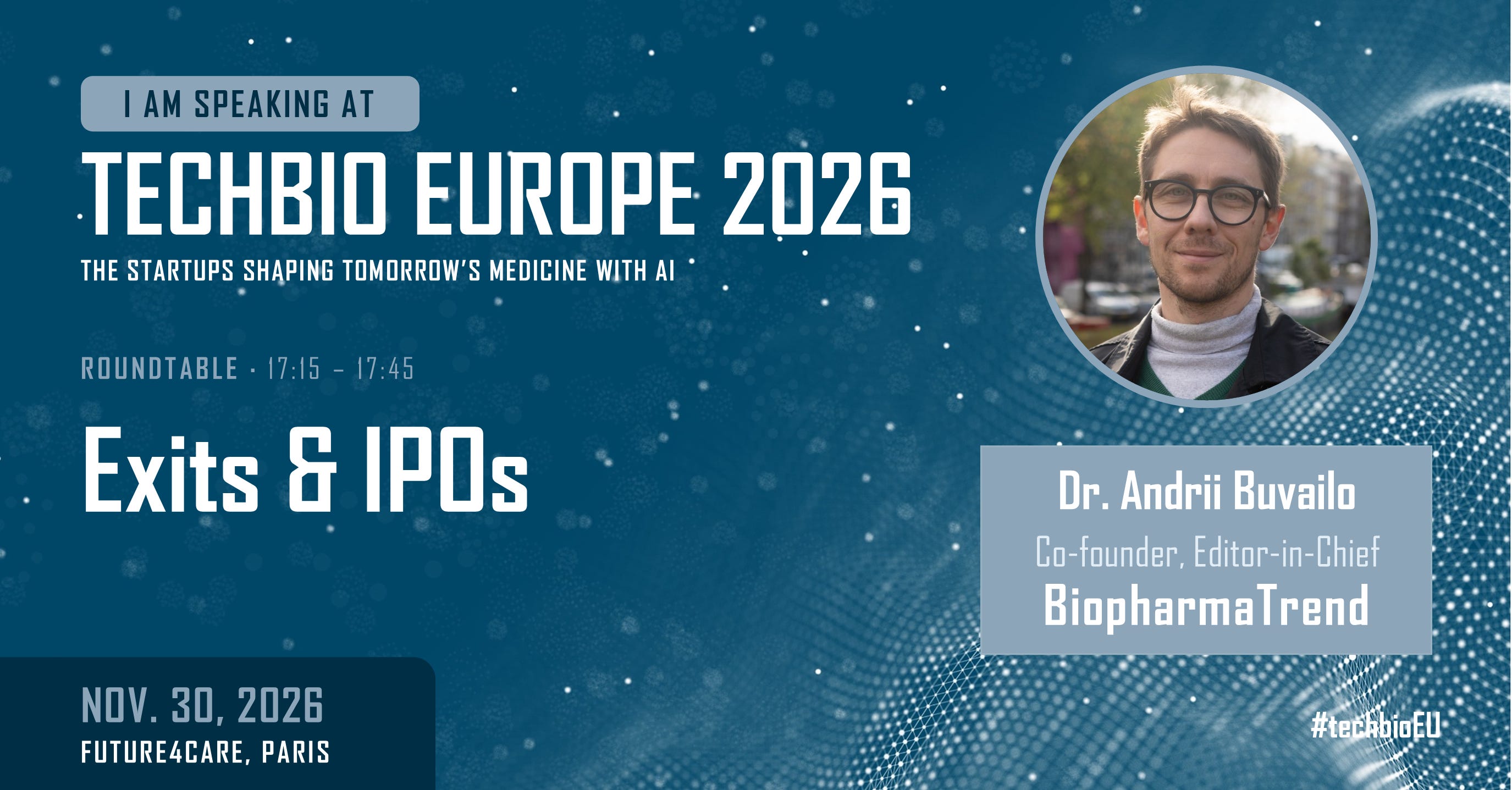
At BioPharmaTrend, we have followed many techbio companies from their first VC rounds all the way to an acquisition or an IPO. Along the way, I have noticed patterns in what the successful exits had in common, and in what held the others back. I’m keen to talk about what European techbio startups/scaleups can learn from them with people who have built and exited companies themselves.
The event will also feature leadership from companies like Sanofi, Bayer, Servier, and OWKIN, who will be discussing how a pilot becomes a $1B+ biobuck deal; Bioptimus, Helical, and the Wellcome Sanger Institute will look at whether Europe has a real advantage in techbio. Merck and Eurofins will talk about the lab bench, and six European startups will pitch. In total, there are 30+ speakers.
Grateful to Timothé CYNOBER, Head of BD&L at WhiteLab Genomics, for the invitation!
📅 November 30 | Panel at 5:15 PM
📍 Future4care, Paris
If you are there, let me know and let’s grab a coffee! ☕
A Thing To Know This Week
Google DeepMind says its chemistry agent did days of prep in about an hour
Google DeepMind released Cheminformatics Skills for Antigravity, its Gemini-based agent platform, which Google is positioning as a workbench for scientists. The skills pair the language model with deterministic tools (RDKit) and databases such as ChEMBL and PubChem.
The demo is a lung cancer case built around crizotinib and lorlatinib, the latter a macrocyclic follow-up that locks down crizotinib’s rotatable bonds. The agent pulled 568 compounds from papers and patents, linked rigidity to potency, trained a potency model, proposed new macrocycles and suggested synthesis routes.
A few caveats. “One hour vs. days” is Google’s own number, not an independent benchmark; what matters is total expert time, including review and correction. None of the molecules has been made or tested, which Google says itself. The real test is traceability: can you follow a recommendation back to the calculation, the record and the paper, with measured data kept apart from predictions?
And it isn’t the first: ChemCrow did something similar, so this seems to be more of a usability and platform play than a new method.
Google is offering its top usage tier free for six months to 10,000 eligible scientists. If you’ve tested it, share your thoughts in the comments: is it workable now?
Strategic Signals…
According to Jeffrey Leiden, Executive Chairman at Vertex, AI is still a scientist’s copilot, not a cure machine
Leiden told the WSJ that Vertex gave about 50 AI companies a dataset of 10,000 compounds, and none came back with a working drug. In his LinkedIn follow-up, he says AI already speeds up protein binder design, while small molecules remain much harder.
According to Liran Belenzon, Founder/CEO at BenchSci, pharma won’t share its most valuable data with the frontier AI labs
Belenzon says R&D heads don’t trust no-training guarantees and expect the labs to compete in drug development. BMS’s new Responsible AI statement puts this in writing: data shared with regulators or partners can’t train non-BMS AI without explicit permission. So frontier models still get in, just inside pharma’s walls and on its terms.
That was last week, and have a great one ahead!
Forward this to a colleague who should be tracking this space,
Cheers!
— Andrii and BiopharmaTrend Team!
Read also:
The $50B Question: How Do We Know If Isomorphic’s AI Works?
The Virtual Cell Tracker: Who’s Building Them, What Works, Where the Money Goes
13 AI Drug Discovery Companies to Watch in 2026