


Welcome to the Where Tech Meets Bio newsletter, where we explore companies, technologies, and scientific breakthroughs shaping the biopharma industry's future!
If this newsletter is in your inbox, it’s because you subscribed, or someone thought you might enjoy it. In either case, you can subscribe directly by clicking this button:
In this issue: AstraZeneca joins a shared 1,152-GPU supercomputer in Sweden as pharma's compute race outpaces its published results — Anthropic's S-1 shows 9 of the 10 largest pharma companies are paying customers — insitro and AI Proteins sign deals worth $1.5B and $400M+ — Iambic prices its IPO while Recursion raises $200M — OpenAI buys Orchestra Bio and sets nearly 2,000 agents loose on a brain atlas — China drafts a ban on foreign takeovers of its CGT and siRNA platforms, and more…

This issue is presented by: Scala Biodesign
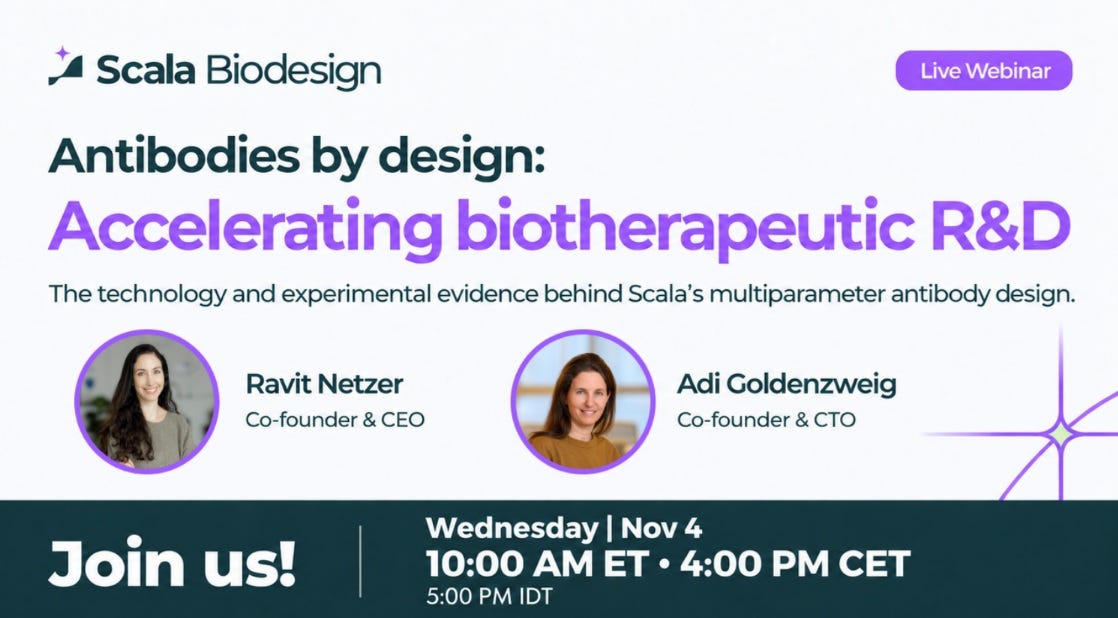
Antibodies by design: fix developability and affinity from the first design round
Live webinar · Wednesday, November 4, 2026 · 10:00 AM ET | 4:00 PM CET | 5:00 PM Israel time
Scala Biodesign combines AI with physics-based calculations to design antibody frameworks and antigen-binding regions, building on a decade of development across antibodies, vaccines, gene therapies and other biotherapeutics.
In this session, co-founders Dr. Ravit Netzer (CEO) and Dr. Adi Goldenzweig (CTO) draw on Scala’s work with top-10 pharma companies and biotechs to walk through experimental antibody case studies: the starting problem, the sequence changes designed, and how variants compare with the parent antibody across affinity and developability assays — which properties improved and which were retained.
You’ll learn how Scala’s design framework addresses:
Stability: aggregation, self-association, polyreactivity and expression yields
Activity: affinity and selectivity
Program constraints: controlling the location and load of mutations
Sequence diversity: antibodies with diverse sequences and V-gene combinations that meet binding and developability requirements, giving teams multiple candidates to advance
Antigens: an antigen design module to improve the expression and stability of antigens and drug targets
Teams developing scFvs, VHHs, multispecifics or ADCs can use the session to assess which design approaches are worth testing in their own programs.
Main Story
On October 15, AstraZeneca and a group of Swedish industrials, including Ericsson, Saab, SEB and Wallenberg Investments, launched Sferical One, a shared NVIDIA supercomputer reportedly built on 1,152 Blackwell Ultra GPUs for more than SEK 1 billion. AstraZeneca plans to use it for drug discovery.
The list goes on. Lilly’s LillyPod has been live since February with 1,016 GPUs, Roche now runs more than 3,500, BMS’s Vera Rubin system is due in Q1 2027, and Novo Nordisk and Zealand Pharma compute on Denmark’s Gefion. The software is following: Boltz will run its models inside BMS’s SuperPOD, trained on BMS data.
What’s still missing is the output. None of these systems has been tied to a published molecule or utilization figure yet, and each “most powerful” claim uses a different yardstick. Lilly’s chief AI officer Thomas Fuchs put it plainly: the bottleneck is biology.
More compute also means more candidates to check. Google’s new Deep Review agent has already verified more than 16,000 manuscripts at major ML conferences, and in drug discovery, Moe Alsumidaie argues the bottleneck has simply moved to clinical validation.
So what should count as a return on a SuperPOD?
🔒 From our members' deep dives: Big Pharma Is Betting On LLMs and Agents. What Would Count As Success? — the deals, and how to measure each kind of value.
The Brief
💰 Follow the Money
A frontier lab files, with pharma on the customer list — Anthropic filed for a Nasdaq IPO under “ANT” today, and its S-1 shows 9 of the 10 largest Fortune 500 pharma companies each spent at least $100,000 with it in the year to Sept 30. The filing lists healthcare and life sciences first among its new markets and names Claude Science as a core product; first-half 2026 revenue was $16.3B, the FT reported.
AI drug discovery tests the public markets — Iambic priced its IPO at $16 a share for $150M on Oct 15, the same day Recursion raised $200M in a follow-on at $3.25 that it says funds operations into 2029. We track the public cohort in 13 AI Drug Discovery Companies to Watch in 2026.
Pricing a platform before the clinic — Isomorphic Labs is reportedly in early talks to raise at a $40B–$50B valuation, Bloomberg reported, after a $2.1B Series B in May.
Robots instead of CROs — Warp Sciences, co-founded by former OpenAI science lead Kevin Weil, launched with $215M led by Lightspeed to automate molecule making and testing in the US, work now often sent to Chinese CROs.
Engineered working dogs — Colossal-backed Warhound raised a $200M seed at a $1.2B valuation to clone and gene-edit military dogs equipped with Anduril gear; first births are expected in early 2027.
Chemistry-native AI — Oakland-based Albert Invent raised a $55M Series B led by TCV for its R&D platform, used by BASF, Henkel and Clorox to retrieve lab knowledge and design formulations.
Patient data from four countries — BioStack raised a $9.5M seed co-led by Peak XV and Afore Capital to build de-identified longitudinal datasets from a claimed 100M+ records in the US, India, Brazil and Argentina.
🤝 Deals & Alliances
Cardiometabolic targets for the Virtual Human — AstraZeneca will pay insitro $40M upfront and up to ~$1.46B in milestones, plus royalties, to take targets in MASH and cardiomyopathies to development candidate.
Miniproteins by design — Astellas licensed AI Proteins’ de novo miniprotein platform in a deal worth more than $400M including milestones.
A milestone and a trial predictor — Insilico hit the first milestone in its $888M oncology deal with Servier and launched inClinico Agent, which reportedly predicts trial efficacy with an AUROC of 0.828 (medRxiv preprint).
Open models, inside the firewall — Boltz will deploy Boltz Lab inside BMS’s NVIDIA SuperPOD and co-develop custom models on BMS data; no terms disclosed.
Exploratory, for now — Oracle and AstraZeneca signed a non-binding agreement to explore AI and real-world data for trial recruitment and evidence generation.
🔬 Science to Watch
Genetics without the lab test — Sooknah, Xu et al. (medRxiv preprint, Apr 14, 2026) at Calico found disease genes directly from AI embeddings of MRI scans, linking a CASP9 variant to kidney failure and an ADGRG6 variant to asthma and COPD, with no blood or breathing tests.
Mapping the nervous system — Precision Neuroscience released a neural atlas from 70 patients and more than 180 hours of recordings with its thin-film brain interface.
Dodo, 95% done — Colossal says its dodo genome is about 95% complete, with ~2,300 candidate gene-editing targets for beak shape still being validated in its closest living relative, the Nicobar pigeon.
Your brain as a password — Paris-based Yneuro, backed by Bpifrance, is building Neuro ID, software that continuously verifies identity from EEG signals in earbuds and smart glasses.
Banking immune cells — Cellino’s Reservoir now cryopreserves people’s immune cells for $5,000 plus $270 a year, betting on future personal cell therapies.
📋 From the Regulators
China moves to keep its platforms at home — China’s Ministry of Commerce proposed banning foreign acquisition of proprietary cell and gene therapy and siRNA platforms; out-licensing and CRO/CDMO services are excluded, and comments are due Nov 15.
A Thing To Know This Week
OpenAI goes full “bio” mode
Nearly 2,000 GPT-Rosalind agents, built by PerturbAI and OpenAI with Scripps Research, analyzed a whole-brain CRISPR atlas of the mouse in 32 minutes — work estimated to take humans months. In blinded comparisons, experts preferred the agents’ interpretations 75% of the time (bioRxiv preprint).
A day earlier, OpenAI acquired Orchestra Bio, whose agents monitor drug programs and flag problems such as a failed manufacturing batch, and folded it into its Rosalind life sciences offering. Put together, OpenAI is building agents for both ends of the pipeline: finding targets upstream and running programs downstream.
Xaira, too, introduced X-Scientist this week, reporting hit rates on par with human-curated picks in a fraction of the time.
Usual caveats apply: preprints, self-reported results, and expert preference is just that — preference. Marketing play or a serious push into biotech?
Strategic Signals…
According to Arjun Murthy of Maven Bio, every bispecific ADC at Phase 3 or later was discovered in China
His team analyzed 243 bispecific and biparatopic ADC programs across 114 developers. Most are still preclinical, but China originated 46 of the 53 clinical programs and all four at Phase 3 or later, while six Western-owned clinical programs have been discontinued since 2018.
The timing matters: several of those Chinese assets, including BMS-partnered iza-bren and CTTQ’s TQB2102, reported Phase 3 data at ESMO in Madrid this week. And 36 of 46 Chinese clinical assets still have no disclosed ex-China deal; those that did, like iza-bren ($800M upfront from BMS) and JSKN016 ($125M upfront from Pathos AI), have set the price.
🧬 Time will tell, but with targets and payloads crowding (23 EGFR × MET programs, and topoisomerase I payloads in at least 77%), Murthy expects follow-on programs to compete on tolerability, dosing and patient selection rather than novelty. Combined with China’s draft limits on selling its platforms, the West’s role looks increasingly like licensing the assets, not owning where they come from.
Want the deep dives? Members get the full analysis of every deep dive plus our complete archive. Become a member →
That was last week, and have a great one ahead!
Forward this to a colleague who should be tracking this space,
Cheers!
— Andrii and WTMB Team!
Read also:
Biotech IPOs Roar Back, With Nvidia-Backed Iambic Next in Line🔒
The $2.7B Question: How Do We Know If Isomorphic’s AI Works?
Big Pharma Is Betting On LLMs and Agents. What Would Count As Success?