
Hi! I am Andrii Buvailo, and this is my weekly newsletter, ‘Where Tech Meets Bio,’ where I talk about technologies, breakthroughs, and great companies moving the biopharma industry forward.
If you've received it, then you either subscribed or someone forwarded it to you. If the latter is the case, subscribe by pressing this button:
I have just published a new video to my Substack podcast, you may be interested in checking it out: How Precision Neuroscience and Drug Synergies Could Advance Neurology
Now, let’s get to this week’s topics!

Weekly Tech+Bio News:
💰 Capstan Therapeutics raises $175M to advance its messenger RNA technology for in vivo CAR-T cell therapies, targeting autoimmune diseases with its lead program, CPTX2309, aiming for more accessible and convenient treatments.
🔬 Johnson & Johnson MedTech partners with Nvidia to develop AI-driven tools for real-time surgical decision-making and clinician education, aiming to advance Surgery 4.0 with edge computing and AI platforms.
🔬 eGenesis successfully transplants the first genetically engineered pig kidney into a living human at Massachusetts General Hospital, marking a potential breakthrough in addressing the global organ shortage and opening a new era in transplantation medicine.
🚀 Mirador Therapeutics debuts with $400M funding to develop precision medicines for immune-mediated inflammatory and fibrotic diseases, leveraging their Mirador360platform, which combines human genetics and data science for therapeutic innovation.
💰 AstraZeneca announces a $2.4bn acquisition of Fusion Pharmaceuticals, specializing in radioconjugates for cancer treatment, marking a strategic move to enhance its oncology portfolio and compete in a market led by Novartis.
🔬 Owkin expands its collaboration with Sanofi to leverage AI for precision drug discovery in immunology, aiming to tailor treatments by identifying candidate gene targets and disease indications
🚀 Aily Labs, founded by ex-Novartis executive Bianca Anghelina, introduces a decision intelligence app for life sciences, achieving profitability in its first year with a 500% customer growth. The Munich startup recently raised $21 million in Series A funding, aiming to become the "Apple of AI" by simplifying organizational workflows across the value chain.
🔬 NVIDIA Healthcare launches a suite of generative AI microservices for the drug discovery, medical technology, and digital health, with over two dozen tools including imaging and molecular interaction models. The company aims to democratize access to advanced AI research tools across the industry.
🔬 GE HealthCare and Nvidia collaborate to launch SonoSAMTrack, an AI-powered research model for ultrasound imaging, enhancing diagnostics by segmenting anatomies and lesions.
🔬 QC Ware collaborates with NVIDIA to enhance drug discovery with Promethium, a quantum-inspired platform, leveraging NVIDIA Quantum Cloud to generate superior training data for AI-driven molecular simulations,
NVIDIA Healthcare Unveils Generative AI Microservices In a Push to “Democratize“ Technology
I can’t say enough how bullish I am about NVIDIA’s plans in life sciences and healthcare.
And here we have a new announcement where NVIDIA has introduced a collection of generative AI microservices, designed to enhance the capabilities in drug discovery, medical technology, and the digital health sectors. This is a kind of boring technical announcement, but it may have a serious impact on the technological advancement in the industry.
What are microservices, after all?
Microservices architecture is an approach to software development where an application is structured as a collection of loosely coupled, independently deployable services, each focused on a specific business capability.

In other words, companies can relatively easily (and I assume with a more flexible pricing model) integrate a very specific tool from the entire NVIDA platform into their R&D workflow and do it quickly. The NVIDIA service kind of becomes a part of your own software package, whatever you have.
I used to run an e-commerce department at a large chemical company, and we would create several microservices for the customers of our online store, so that they could automatically get all the information about molecules and molecular parameters directly into their drug design software.
So, our customers could get molecular data, pricing, and availability of molecules in real time while designing a lead compound in whatever software they normally use.
Coming back to NVIDIA microservices…
The suite comprises more than two dozen microservices, including advanced solutions for imaging, natural language and speech recognition, and digital biology generation, prediction, and simulation.
These services are built on NVIDIA NIM™ AI models and are integrated with industry-standard APIs to facilitate the development of cloud-native applications. The initiative is designed to assist healthcare enterprises globally to capitalize on generative AI technologies across various platforms, including cloud and on-premise setups.
Among the tools provided are NVIDIA accelerated software development kits such as Parabricks®, MONAI, NeMo™, Riva, and Metropolis, now accessible as NVIDIA CUDA-X™ microservices.
The NVIDIA NIM Healthcare Microservices for Inferencing includes a range of optimized inference models for applications in imaging, medtech, drug discovery, and digital health. It also features models for generative chemistry, protein structure prediction, and molecular interaction understanding, aimed at bolstering drug discovery efforts.
Notably, Cadence, a computational software company, is integrating NVIDIA BioNeMo™ microservices into its Orion® molecular design platform.
The healthcare microservices have already seen adoption by nearly 50 application providers, biotech and pharma companies, and medical imaging software makers, demonstrating the broad interest and potential impact of this technology in the healthcare sector.
In addition to advancing drug discovery and medical research, these microservices also aim to improve patient and clinician interactions.
Companies like Hippocratic AI and Abridge are developing AI-powered platforms and agents to facilitate patient engagement and streamline clinical documentation processes, respectively.
Availability of these microservices extends to developers through the NVIDIA AI Enterprise 5.0 software platform, with support for NVIDIA-Certified Systems™ from leading technology providers and cloud platforms.
Basically, NVIDIA is building the industry-wide software infrastructure for AI-driven research. And, of course, NVIDIA controls the hardware part, the GPUs, so it seems like the company is going to be a big deal in pharma/biotech/healthcare over the coming years (certainly not a financial advice, just in case, I do not even have NVIDIA stocks at the moment).
Availability: developers can experiment with NVIDIA AI microservices at ai.nvidia.com and deploy production-grade NIM microservices through NVIDIA AI Enterprise 5.0 running on NVIDIA-Certified Systems™ from providers including Dell Technologies, Hewlett Packard Enterprise, Lenovo and Supermicro, leading public cloud platforms including Amazon Web Services (AWS), Google Cloud, Microsoft Azure and Oracle Cloud Infrastructure, and on NVIDIA DGX™ Cloud.
New AI Model Designs Antibodies From Scratch
Researchers, under the guidance of David Baker at the University of Washington, used a generative AI model developed in their lab, to successfully engineer an antibody that neutralizes a bacterial toxin alongside three others targeting the viruses responsible for Covid-19, RSV, and the flu.
This innovative research, detailed in a study published on bioRxiv, demonstrates the capabilities of their AI model in crafting antibodies that precisely target proteins as intended by their creators.
This method diverges from traditional approaches that involve searching through the blood of mice or humans for suitable antibodies.
The utilization of AI in de novo protein design, aiming to generate novel proteins not found in nature, holds real potential for the pharmaceutical industry and for synbio.
Baker's Institute for Protein Design created binding proteins that, until now, were simpler compared to the complex structures of standard antibodies.
The institute's latest work with the RFdiffusion software showcases AI's ability to design antibodies that precisely align with specific targets on bacterial or viral proteins, a significant advancement over traditional methods.
The successful prediction and validation of these antibody structures through high-powered microscopy underscore the accuracy of the AI model, marking a "a-ha moment" for the researchers involved.
Watch a video in this LinkedIn post of how RFdiffusion software creates an antibody in real time:
Still Challenging…
Critiques from the scientific community highlight that while the work represents a significant step forward, the developed antibodies currently lack the strong binding affinity necessary for therapeutic applications.
David Baker acknowledges this limitation, emphasizing the need for further refinement before these antibodies can be considered for drug development.
Nicholas Polizzi, a protein scientist at Dana-Farber Cancer Institute, points out the limitations posed by insufficient data and the initial focus on targets with existing antibodies, suggesting room for growth in tackling more novel and challenging drug targets.
AI-driven antibody design is on the rise
I have explored the topic of AI-driven antibody design in one of the previous newsletters, but just to mention a couple of notable companies in this space:
Generate:Biomedicines, Absci, BigHat Biosciences, Nabla Bio, and Cradle.
Here is my video-interview with Dr. Elise de Reus, Co-founder of Cradle, where she explains how the company applied generative AI for designing protein-based therapeutics, including antibodies.
These 22 Biotechs Raised Collectively $3.3 Billion in Q1 2024. What Do They Have to Offer?
The biotech industry is experiencing a big wave of investment, similar to the high levels seen between 2020 and 2021.
In just the last three months, there's been a rush of big money deals, with companies like Engrail Tx, Clasp Tx, Capstan Tx, and Mirador Tx announcing large funding amounts of $157 million, $150 million, $175 million, and $400 million, respectively.
Since the beginning of the year, 22 biotech startups have raised over $100 million each, representing more than a dozen of therapeutic areas (see table below).
Investors are showing interest in companies that are close to or in the middle of clinical trials, which means they're testing their treatments on people. For instance, out of the 22 biotech startups with significant rounds in 2024, only 6 are in the preclinical stage.
Another quite expected insight, as you can see in the table, is that the majority of them, 10 companies, are focused on oncology as a key area:
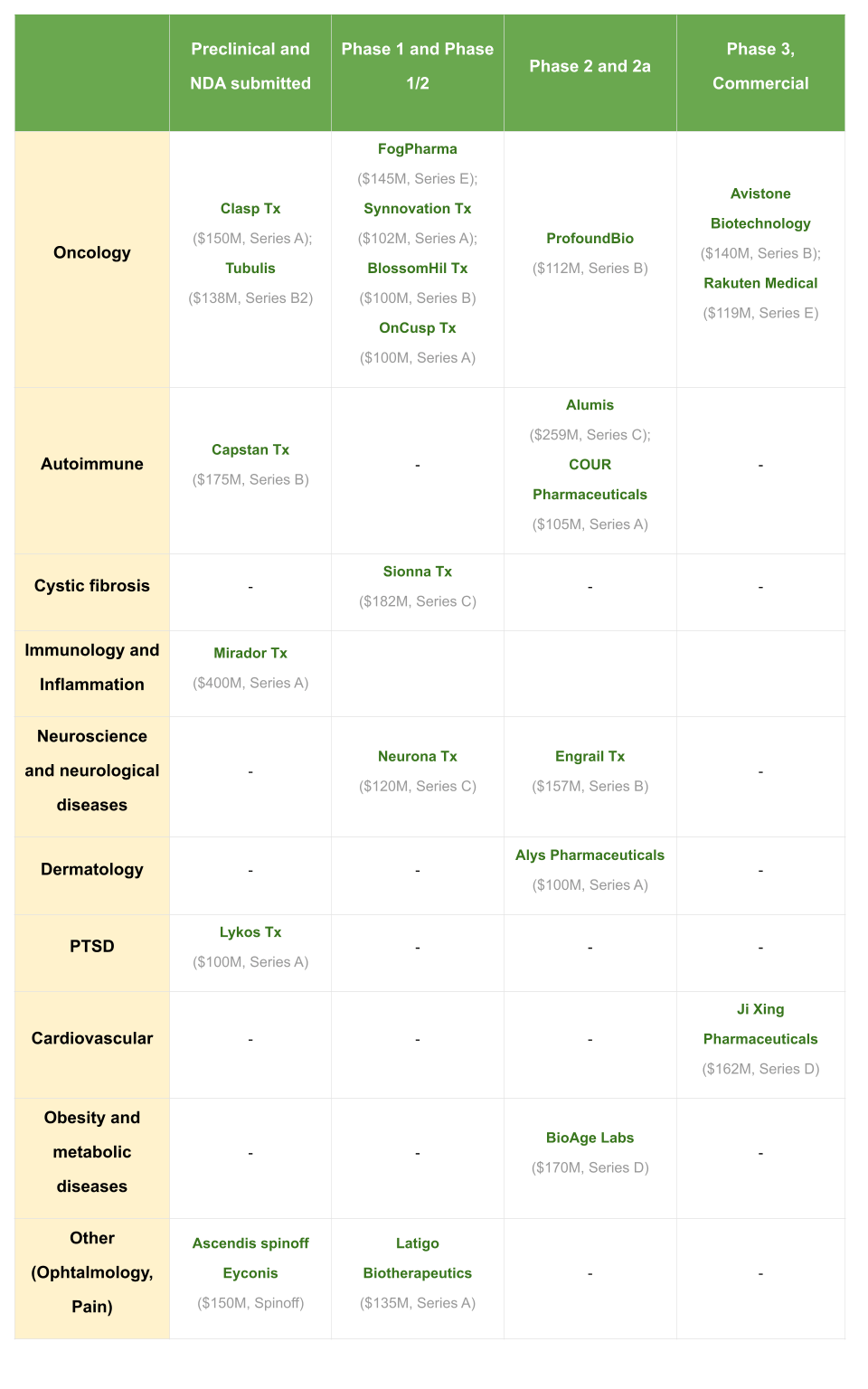
This shift towards funding more mature companies suggests investors are looking for safer bets, learning from past investments in very early-stage projects that didn’t pan out.
In any case, the current biotech investment climate is great news for companies working on cutting-edge science, especially those working on new treatments that need a lot of money to start up, like cell and gene therapies.
Now, let’s have a look at some of the companies from the list, focusing mostly on tech platforms or AI-driven companies:
Alumis
Alumis focuses on developing oral therapies for immune-mediated diseases, using a precision approach to target immune dysfunction. Their pipeline includes therapies designed to optimize clinical outcomes through careful selection of targets, molecules, indications, and patient groups.
Recently, Alumis announced a $259M Series C financing to advance its clinical-stage pipeline, including ESK-001, an oral allosteric TYK2 inhibitor for plaque psoriasis, which showed positive data in a Phase 2 trial.
This March, Alumis announced positive results from a Phase 2 trial of ESK-001 for plaque psoriasis at the AAD Meeting, showing high efficacy and safety, with Phase 3 trials planned for 2H 2024.
Capstan Therapeutics
Capstan Therapeutics is a biotechnology company founded in 2021, based in California, USA. It is dedicated to advancing in vivo cell reprogramming through targeted lipid nanoparticles, focusing on developing therapeutics for a broad spectrum of diseases.
Capstan's core platform technology specializes in expanding the therapeutic potential of in vivo RNA-based therapies through proprietary targeted delivery systems.
Recently, the company announced a $175 million oversubscribed Series B financing, highlighting its mission to multiply therapeutic possibilities for patients by developing targeted in vivo RNA technologies. Capstan Therapeutics is actively developing medicines that reprogram cells inside the body, positioning itself at the forefront of in vivo cell therapy innovation.
BioAge Labs
BioAge Labs, a clinical-stage biotechnology company focused on developing treatments for obesity and metabolic diseases by harnessing the biology of aging, recently announced the completion of a $170 million oversubscribed Series D financing round.
BioAge Labs' AI-driven discovery platform systematically analyzes biomarkers from longitudinal aging data to uncover key molecular pathways that influence human longevity. This approach enables the identification of potential therapeutic targets and the development of novel treatments for metabolic diseases, with a specific focus on mechanisms that have been validated to extend healthy lifespan in humans.
The funding is earmarked for Phase 2 clinical development of BioAge’s lead compound, azelaprag, an oral apelin receptor agonist, in combination with Lilly’s Zepbound (tirzepatide) and other incretins for the treatment of obesity. This collaboration with Eli Lilly’s Chorus organization aims to initiate studies by mid-2024.
Azelaprag has shown promise in a Phase 1b trial, promoting muscle metabolism, increasing energy expenditure, and preventing muscle atrophy in healthy older volunteers at bedrest.
Preclinical studies also indicated that azelaprag could double the weight loss achieved with incretin drugs, with improvements in body composition and muscle function.
Tubulis
Tubulis is a biotechnology company dedicated to reimagining antibody-drug conjugates (ADCs) for the treatment of solid and hematologic tumors.
Tubulis employs a comprehensive suite of proprietary technologies, including the P5/Tubutecan platform, to create uniquely matched ADCs, offering innovative solutions for overcoming historical challenges associated with ADC development and expanding their applicability in oncology.
Tubulis also utilizes proprietary TUB-TAG technology, to generate uniquely matched antibody-drug conjugates. The TUB-TAG platform is a chemical conjugation approach that enables the precise and stable attachment of drugs to antibodies, aiming to improve the therapeutic index and effectiveness of ADCs across a range of indications.
The company recently closed an upsized €128 million Series B2 financing round to accelerate the clinical development of its ADC pipeline focused on solid tumors.
Engrail Therapeutics
Engrail Therapeutics, a clinical-stage biopharmaceutical company founded in 2019, specializes in developing transformative medicines for neurologic, neuropsychiatric, and neurodevelopmental disorders.
Engrail's research includes modulation of GABA and dopamine pathways, aiming for enhanced therapeutic effects with minimal side effects compared to traditional treatments.
Their lead clinical compounds, such as ENX-102, target GABAA receptors for disorders like generalized anxiety, while also exploring treatments in dopamine modulation for depression and copper transport mechanisms for diseases like Menkes disease. Engrail's approach represents a promising advancement in precision neuroscience.
Engrail Therapeutics recently closed an oversubscribed $157 million Series B financing round raising the company's total to over $220 million since its 2019 inception.
Neurona Therapeutics
Neurona Therapeutics is a clinical-stage biotherapeutics company dedicated to developing regenerative cell therapies aimed at repairing the nervous system. By focusing on the targeted repair of dysfunctional neural circuits underlying chronic diseases, Neurona leverages the potential of neural cell therapies to provide long-lasting disease amelioration. Their innovative approach involves the development of allogeneic, off-the-shelf neural cell therapies for various chronic neurological disorders, including a leading candidate, NRTX-1001, a first-in-class inhibitory neuron therapy for epilepsy. This approach promises curative outcomes from a single, one-time dose by permanently integrating into neural circuits, replacing affected cells, and rebalancing dysregulated electrical activity.
Neurona raised $120 million in February 2024 to further advance its innovative pipeline of regenerative cell therapy candidates for chronic neurological disorders.
Clasp Therapeutics
Clasp Therapeutics is focused on revitalizing the promise of immuno-oncology through next-generation T cell engagers (TCEs) designed for precision medicine. The company aims to expand the reach of immuno-oncology with innovative therapies that allow the immune system to specifically identify and destroy hard-to-treat tumors bearing common driver mutations. By targeting mutated protein fragments displayed by specialized HLA molecules on cancer cells, Clasp seeks to target the majority of cancer-driving proteins that are not accessible to traditional antibody-like drugs. Their approach promises enhanced tumor specificity and the potential for creating precision treatments across a wide spectrum of driver mutations in various cancer types, representing a significant advancement in the treatment of neuropsychiatric and neurologic disorders.
Clasp Therapeutics recently launched with a $150 million Series A financing, co-led by notable investors including Novo Holdings, Third Rock, and Catalio.
Fogpharma
FogPharma is at the forefront of developing a novel class of precision medicines known as Helicons™, aiming to transcend the limitations of current precision therapies and achieve universal druggability.
As a clinical-stage entity, FogPharma uses an innovative discovery engine to enable the creation of Helicon therapeutics against challenging targets across various disease areas.
Helicons uniquely combine the targeting capability and specificity of antibodies with the extensive tissue distribution and intracellular engagement typical of small molecules.
FogPharma's flagship program, FOG-001, is a pioneering TCF-blocking β-catenin inhibitor undergoing Phase 1/2 clinical trials, marking a significant step toward addressing previously intractable cancer drivers.
FogPharma recently announced a significant $145 million financing round on March 1, 2024.