
Hi! I am Andrii Buvailo, and this is my weekly newsletter, ‘Where Tech Meets Bio,’ where I talk about technologies, breakthroughs, and great companies moving the biopharma industry forward.
If you've received it, then you either subscribed or someone forwarded it to you. If the latter is the case, subscribe by pressing this button:
Now, let’s get to this week’s topics!

Weekly Tech+Bio News:
The last week was very busy with announcements, in particular, from Ginkgo Bioworks (which, in my opinion, broke a record for a per-single-day announcement density).
💼 Bristol Myers Squibb completes a $4.1bn acquisition of RayzeBio, expanding its portfolio with a new radiopharmaceutical pipeline, including a leading therapy, RYZ101, aimed at treating neuroendocrine tumors and lung cancer.
💰 Novo Nordisk enters a $1.46bn agreement with Neomorph to develop molecular glue degraders for cardiometabolic disorders and rare diseases, marking a significant investment in targeting previously 'undruggable' diseases with advanced therapeutics.
🔬 FB1006, an AI-discovered drug, enters clinical trials for ALS treatment, showing potential in addressing the progressive degeneration of nerve cells.
Developed by 4B Technologies and Insilico Medicine, this innovative approach integrates AI at multiple stages, including target identification and efficacy assessment, aiming to expedite drug development and offer new hope to ALS patients.
💰 ORI Capital secures $260M for its second life sciences fund, ORI Fund II, targeting early-stage biotech innovations in diagnostics, drug delivery, and therapeutics for high-mortality diseases. With a focus on AI and big data through its ORIZON platform, ORI aims to support the next generation of biotech companies addressing significant unmet medical needs.
🚀 Cradle joins forces with Ginkgo Bioworks to enhance AI-driven protein engineering, becoming a key part of the Ginkgo Technology Network. This partnership aims to make advanced Machine Learning tools accessible to more bio R&D teams, speeding up the design of optimized proteins with a significant increase in productivity and a reduction in experimental rounds required.
💼 Ginkgo Bioworks acquires Reverie Labs, enhancing its AI-driven drug discovery capabilities with key assets and expertise in AI/ML for biological discovery. This move aims to accelerate the development of next-generation biological foundation models and strengthen Ginkgo's discovery services, leveraging Reverie's generative AI platform to advance small molecule programs and engineer biology more efficiently.
💰 Abridge secures $150M to enhance its AI-driven clinical documentation platform, marking significant growth in the healthcare AI sector. This funding will support R&D and expand its impact across U.S. health systems, including a new partnership with Yale New Haven Health System for improved clinical documentation and patient care.
🔬 Together AI unveils Evo, a pioneering biological foundational model for analyzing and generating DNA, RNA, and protein sequences, trained on 2.7 million prokaryotic genomes. Evo, featuring the innovative StripedHyena architecture, excels in tasks like zero-shot gene essentiality testing and novel CRISPR system design, aiming to revolutionize fields from drug discovery to sustainability.
🔬 QIAGEN launches QIAGEN Biomedical KB-AI, a generative AI-driven knowledge base, to revolutionize data-driven drug discovery. Offering over 600 million biomedical relationships, it aims to enhance understanding of disease mechanisms, drug targets, and biomarker identification, significantly expanding the scope of research for data scientists and bioinformaticians in the pharma and biotech industries.
🔬 Australia-based CRO Avance Clinical partners with Ryght to integrate generative AI technology into clinical trial processes
💰 Baseimmune, a UK-based startup leveraging AI for vaccine development against future pathogen mutations, secures £9M in Series A funding. The investment, led by MSD Global Health Innovation Fund and IQ Capital, underscores the growing focus on AI's potential in biotech, particularly for creating adaptable vaccines for pandemic preparedness.
🚨 Change Healthcare, a leading US health tech company, confirmed a cyberattack causing widespread system disruptions. This incident has impacted services nationwide, including prescription processing capabilities, with effects felt by local pharmacies and healthcare providers. The attack highlights the vulnerability of critical healthcare infrastructure to cyber threats.
🔬 Pramana, an AI-enabled health tech company, joins Proscia Ready to enhance pathology data utility with high-quality DICOM images, advancing cancer research and diagnostics. Through integration with Proscia's Concentriq platform, laboratories will benefit from enriched whole slide imaging and improved sample preparation analysis.
🔬 Optibrium introduces Semeta, a cutting-edge AI-driven metabolism prediction software for DMPK scientists, aimed at enhancing drug discovery with precise Phase I and II metabolic predictions, utilizing quantum mechanics and machine learning for improved efficiency and accuracy.
💰 Curve Therapeutics secures £10M from British Patient Capital, contributing to a £40.5M Series A funding round alongside Pfizer Ventures and others. This investment will accelerate the development of Curve's Microcycle® intracellular screening platform for novel cancer treatments, showcasing the UK's commitment to advancing life sciences innovation.
📈 Investors Flock Back to Biotech After a Long, Cold Spell (WSJ)
📈 The biotech market's key stock index, $XBI, exceeded the $100 mark, signaling a resurgence of investor optimism in the drug development industry after a tumultuous two-year period.
🔬 Medidata and Thermo Fisher Scientific's PPD Clinical Research Business renew collaboration to enhance clinical trial efficiency through Medidata's platform, including AI-powered PPD TrueCast for predictive modeling. This partnership aims to expedite studies, improve drug development productivity, and accelerate the delivery of life-changing treatments.
🚀 PulseSight Therapeutics launches with seed financing to advance non-viral gene therapies for severe retinal diseases, focusing on age-related macular degeneration. Backed by Pureos Bioventures and ND Capital, the company aims to clinically validate its minimally-invasive delivery technology, targeting significant unmet needs in ophthalmology.
🔬 Sam Altman-backed 1910 Genetics collaborates with Microsoft, leveraging Azure Quantum Elements to create a cloud platform that accelerates drug discovery through AI and high-performance computing
🔬 Lantern Pharma's AI platform, RADR®, surpasses 60 billion data points, targeting 100 billion in 2024, to accelerate the development of innovative cancer therapies, focusing on drug sensitivity, combination treatments, and biomarker data in rare cancers, as well as enhancing generative AI capabilities for molecular optimization.
I am happy to remind you that BiopharmaTrend.com is a media partner for the RNA Leaders Europe Congress, the upcoming event in Basel, Switzerland, and I will be there in person.
If you plan to be there too, just let me know, and we can grab coffee and discuss deep-tech in bio!

Event Date: March 13, 2024 - March 14, 2024
Location: Switzerland, Congress Center, Basel;
Register: Link; Exclusive promo code for our readers (15% OFF): MMBT15
The Making of "Super-Platforms" in Bio?
It was a wild day for this biotech unicorn.
On February 28, Ginkgo Bioworks (NYSE: DNA), a notable player in the field of synthetic biology, announced the acquisitions of two AI-driven drug discovery startups, Reverie Labs and Patch Biosciences, and an RNA platform company, Proof Diagnostics — in a single day.
The acquisitions are part of Ginkgo's broader strategy to enhance its research and development offerings through a new Ginkgo Technology Network, a pioneering ecosystem, comprising over 25 partners across various sectors such as AI, genetic medicines, biologics, and manufacturing. The aim is to enhance customer R&D programs through integrated capabilities.
Currently, the Ginkgo Technology Network includes such companies as Cradle (watch my interview with their co-founder, Dr. Elise de Reus), BioMap, BioSymetrics, Turbine, Menten.AI, and Culture Biosciences, to name a few.
The Ginkgo Technology Network was also announced on February 28 (!), which made this day somewhat unusual, not only for Ginkgo but for the sector in general: 3 M&As + a new ecosystem, not bad.
With over 15 years of experience in integrating platform technologies and forming strategic partnerships, Ginkgo stands as a veteran systems integrator. Now the company makes a quite vivid move to broaden its service offerings with this network, as well as with newly acquired startups.
Among the companies acquired is Proof Diagnostics, a firm based in Cambridge, Massachusetts, that has gained attention for its development of a "future-proof" COVID-19 screener.
This technology, which also has the potential to detect other diseases such as the flu and respiratory syncytial virus, utilizes CRISPR gene-editing technology for rapid analysis.
Proof Diagnostics, co-founded by Feng Zhang of the Broad Institute of MIT and Harvard, has been recognized for its innovative OMEGAs technology—an emerging class of RNA-programmable, non-Cas enzymes that offer a promising alternative to current genomic medicine tools due to their compact size and diversity.
The acquisition of Proof Diagnostics is aimed at bolstering Ginkgo's gene therapy services by integrating OMEGAs into its gene editing toolkit, offering a more versatile approach to genomic medicine.
The second acquisition involves Patch Biosciences, a New York-based developer of AI platforms designed to create cargos for genetic medicines.
Patch Biosciences is known for its use of machine-learning models and assays that will now enhance Ginkgo's existing services, adding valuable capabilities and resources to its genetic medicine toolkit.
Finally, Ginkgo has acquired Reverie Labs, a Cambridge, Massachusetts-based company specializing in AI-powered drug discovery.
This acquisition includes Reverie Labs' advanced infrastructure and software, pivotal in training large-scale AI foundation models. Furthermore, four crucial members of the Reverie AI team, including Chief Technology Officer Ankit Gupta, who will take on the role of Head of AI/ML Advancement at Ginkgo, are set to join the company.
This integration aims to enhance Ginkgo's AI/ML-driven discovery services and expedite the development of next-generation biological foundation models. The newly joined Reverie team will play a crucial role in assimilating Reverie’s technology into Ginkgo’s expanding AI/ML infrastructure, as well as in the future development and application of AI/ML techniques in biological engineering.
Ginkgo plans to incorporate Reverie's models, software, and workflows to advance its AI/ML-driven experimental design infrastructure. Additionally, Reverie’s generative AI platform for chemistry will be integrated into Ginkgo's toolkit to bolster small molecule programs.
Ginkgo’s current AI/ML initiatives include Owl, an AI-guided design tool that complements a comprehensive suite of computational tools vetted by Ginkgo’s enzyme engineering team across numerous projects.
The company has also engaged in several strategic collaborations aimed at advancing biological engineering and biosecurity, including partnerships with Google Cloud, Merck, Pfizer, and Boehringer Ingelheim.
Is Ginkgo Destined to Become a Tesla of Biotech?
Disclaimer: This is not financial advice! Conduct your own research.
Much as I personally favor Ginkgo Bioworks (disclaimer: I own a tiny amount of stock there, under $1k worth of value, just because I like the company, long position), the company has been a disappointment for long-standing stock market investors so far.
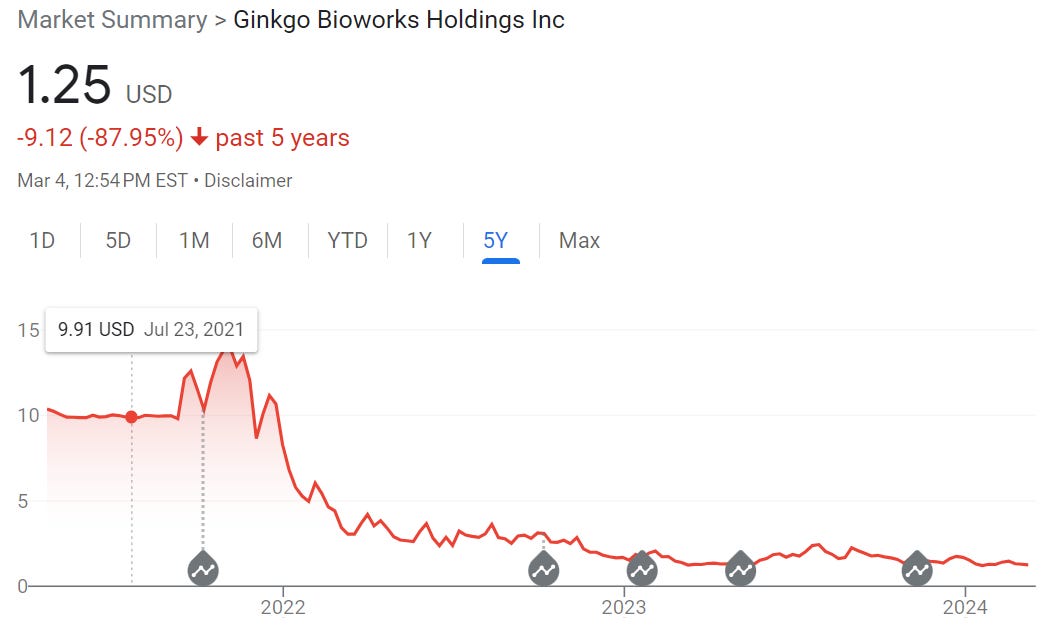
After an impressive Feb 28, 2024, as we’ve just discussed above, the next day Ginkgo reported fairly unimpressive Q4 and full-year 2023 financial results.
But by no means am I trying to become a stock market analytics newsletter, but sometimes it is interesting to have a look at the financials, what is going on behind polished press releases:
Fourth Quarter 2023 Financials:
Revenue: $35 million, a decrease of 65% from $98.3 million in Q4 2022, and below the consensus Wall Street estimate of $42.5 million. The decline was primarily due to the ramp down of K-12 COVID-19 testing and non-recurring equity milestones in cell engineering.
Net Loss: $211.7 million, or $.11 per share, wider than a loss of $175.5 million, or $.10 per share, in Q4 2022, and missing the consensus estimate of a $.10 loss per share.
R&D Expenses: $117 million, down 34% from $177.5 million in Q4 2022.
G&A Expenses: $89.2 million, down 27% from $121.4 million in the previous year.
Full Year 2023 Financials:
Total Revenue: $251.5 million, a 47% decrease from $477.7 million in the previous year, missing the consensus estimate of $258.7 million.
Cell Engineering Revenue: $143.5 million, nearly flat compared to $143.7 million last year. Cell engineering services revenue was $139 million, up 31% over the prior year.
Biosecurity Services Revenue: $79.0 million, down 74% from $298.6 million in 2022.
Biosecurity Product Revenues: $28.9 million, down 19% from $35.5 million.
Net Loss: $892.9 million, or $.46 per share, compared to a loss of $2.1 billion, or $1.25 per share, in 2022, missing the consensus Wall Street estimate of a $.44 loss per share.
Cash and Cash Equivalents: $944.1 million as of Dec. 31.
2024 Outlook:
Total Revenue: Expected to be in the range of $215 million to $235 million.
Cell Engineering Revenue: Forecasted to be in the range of $165 million to $185 million.
Biosecurity Revenue: At least $50 million.
New Cell Programs: The company expects to add 100 to 120 new cell programs in 2024.
Predictably, shares of Ginkgo Bioworks were down 11 percent at $1.36 in Friday morning trading on the New York Stock Exchange, and today, March 4, they are valued at $1.25.
It is a weird situation, where we have basically very cheap (penny) stock for a company with a valuation above $2 billion, especially considering it used to be above $15 billion several years ago.
So, here is the question, does Ginkgo have what it takes to become the first super-platform for biotech?
The company is probably the most powerful systems integrator I know in the field. And they are rapidly building a horizontally integrated ecosystem, pretty much like NVIDIA with Clara Discovery.
They also have vertical integration, which is important for the unit economics of complex biological products. They have abmitious vision, and almost $1 billion in cash in the bank, still.
They invested in AI, building an AI foundation model for biotech (e.g. recent cooperation with Google Cloud), and have now acquired 2 more AI startups.
And yet, the financial history is kind of… worrisome, to say the least. Time will tell if my tiny amount of stock can convert someday to a decent fortune if Ginkgo adjusts and disrupts biotech big time, or, in the worst case scenario, I will lose just a tiny bit of money.
Sam Altman-backed Startup Partners with Microsoft to Enable the AI Infrastructure for Drug Discovery
A new five-year commercial agreement and go-to-market collaboration aims to merge 1910 Genetics' comprehensive computational and biological data with Microsoft’s HPC platform, Azure Quantum Elements.
This union is expected to provide researchers worldwide access to a specialized cloud platform designed to expedite scientific discovery by leveraging the combined strengths of AI and HPC.
Founded in 2018 and based in Cambridge, Massachusetts, 1910 Genetics merges AI, computational analysis, and biological automation to expedite the creation of small-molecule and protein therapeutics. In 2021, the company raised a combined Seed and Series A funding of $26.1M backed by M12-Microsoft’s Venture Fund, Playground Global, OpenAI’s Sam Altman, and other leading investors.
By merging AI-driven drug design with wet lab automation, the company aims to enhance productivity, reduce failure rates in pharmaceutical R&D, and improve the efficiency of drug discovery processes. Leveraging its multi-platform engines, ELVIS™ and ROSALYND™, 1910 Genetics is capable of generating novel drug candidates more swiftly and cost-effectively, enhancing success probabilities compared to conventional pharmaceutical approaches.
The company's technology is modality-agnostic and supports the entire early drug discovery process, from novel hit discovery through lead optimization. 1910 Genetics is actively applying its technology to various therapeutic areas, including neuroscience, infectious diseases, immunology, and oncology.
“We are thrilled to be collaborating with 1910 Genetics to bring their pioneering AI drug discovery engines to Azure Quantum Elements,” said Jason Zander, Executive Vice President of Strategic Missions and Technologies at Microsoft.
Building on the Lab Automation Trend
For initial discovery, 1910 Genetics utilizes SUEDE™, a gigascale virtual screening platform capable of evaluating 14 billion molecules in under six hours to pinpoint potential hit compounds. This efficiency starkly contrasts with conventional methods that take up to six months for physical high-throughput screening (HTS), which has a success rate of less than 0.01%.
As the process advances from hit discovery to lead generation, the company employs BAGEL™, a generative chemistry platform that accelerates the development of lead compounds from identified hits, reducing a process that could take up to 24 months to just two months.
Additionally, 1910 Genetics emphasizes the importance of balancing a drug candidate's potency with its absorption, distribution, metabolism, excretion, and toxicity (ADMET) profile. To achieve this, from the outset of discovery and particularly during lead optimization, CANDID™, a physical property prediction platform, is used for multi-parameter optimization.
These AI platforms are seamlessly integrated with the company's in-house biological automation wet lab platform through cloud computing. This setup conducts in vitro biochemical and cell-based assays on drug candidates, creating a feedback loop to the AI platforms and establishing a unique and proprietary data set.
For protein design, 1910 Genetics is developing ROSALYND™, aimed at refining, predicting, and designing 3D protein structures more rapidly, affordably, and accurately than traditional methods like X-ray crystallography.
This capability can help streamline the process for pharmaceutical R&D teams, reducing both the time and cost associated with developing novel lead molecules for a broad spectrum of therapeutic targets and diseases, including neuroscience, infectious diseases, autoimmune diseases, and cancer.
Realizing that AI-driven transformation of drug discovery is only possible with sufficient amount of biological data, more companies are investing into building proprietary highly automated laboratories for preclinical experimentation.
For instance, in 2022 BiopharmaTrend reported that Insilico Medicine raised a $60 million Series D to invest into building a next-gen robotic lab in China, the facility that was launched in January 2023. Other notable AI-driven drug discovery companies in this lab automation space include Arctoris, Recursion Pharmaceuticals, and Insitro, to name a few.
Microsoft’s Increasing Footprint in Science
In June 2023, Microsoft introduced Azure Quantum Elements (AQE), a supercomputer for chemistry that contains AI models trained on hundreds of millions of molecules. It is designed as an expert in chemistry and materials science, and, using generative AI, a “Copilot for Azure Quantum” to write code and answer tough questions for computational chemists and material scientists.
Just six months after launching, on January 9, 2024, Microsoft announced its first concrete case study in Azure Quantum Elements for chemistry, demonstrating that Azure Quantum Elements used advanced AI to screen 32.6 million candidates in record time to discover and synthesize a new material that could reduce the use of lithium in batteries by 70 percent, paving the way for the next generation of sustainable batteries.
This discovery is a first-of-its-kind in the application of AI for scientific discovery for the design of new materials and foreshadows the transformative potential of Azure Quantum Elements to increase productivity in more industries, including pharmaceuticals.
Building the Infrastructure Layer for Drug Discovery
With the announcement, 1910 Genetics and Microsoft expand their relationship into a commercial agreement that combines the biotechnology company’s massive computational and wet lab biological data, robotics-driven laboratory automation, and multimodal AI models for drug discovery with Azure Quantum Elements.
Together, the companies will build arguably the most powerful, fully integrated AI-driven drug discovery and development platform, with the goal of demonstrating significant cost and time savings for pharmaceutical companies engaged in the R&D of small and large molecule therapeutics for a variety of target classes and disease areas.
“Azure Quantum Elements brings the most powerful AI engine created to facilitate this new AI for Scientific Discovery wave,” said Zulfi Alam, Corporate Vice President of Quantum at Microsoft. Together with 1910, Microsoft is charting a course for a billion-dollar business in AI-driven drug discovery and development.
"1910 Founder and CEO Jen Nwankwo adds: We believe that as the biopharma industry prepares for the inevitable transition from human-intensive, rational drug design to AI-enabled discovery with generative AI at the frontier, the winning companies will, like 1910, be those who innovate across the entire drug discovery tech stack to use optimized, high-performance computing today and quantum computing tomorrow, in concert with high-throughput lab automation to generate large-scale, multimodal data sets. By bringing 1910 and Azure Quantum Elements together, we enable biopharma companies worldwide to realize the potential of AI and reverse decades of declining R&D productivity."
Potential customers interested in learning more about 1910 Genetics’ small and large molecule drug discovery platform in Azure Quantum Elements can sign up here for early access.
The Afterthought
Well, it seems Ginkgo is on the way to building the first “super-platform“ for biotech.
“Super-platforms” are not a new term.
I was talking about it back in 2018, and here is my article: Get Ready For “Super-platforms” In Healthcare and Pharmaceutical Research
A “super-platform” is a term that describes a phenomenon in a modern technological world -- an online-to-offline (O2O) type of digital infrastructure, that spans across multiple sectors of economic activity, providing a way for users (both businesses and consumers) to operate with multiple resources, products, and services within a uniform, standardized, and highly interconnected way.
One of the most illustrative examples of a super-platform in the healthcare industry is Chinese internet giant Tencent, which has become the number one e-health solution in this country.
Before moving to healthcare, Tencent already had WeChat, an “app for everything” in China. People used WeChat every day for managing almost all kinds of daily activities -- from communication to shopping, transferring money, and paying for all sorts of consumer services available there.
Essentially, WeChat was already a super-platform in its own right, when, in 2014, Tencent penetrated healthcare industry with it and provided users an opportunity to access all sorts of medical services: get medical online consultations, book appointments with doctors, make payments for drugs and services at hospitals, etc. Over 38 000 medical institutions already had WeChat accounts in 2017 and were able to serve their patients via Tencent’s digital infrastructure.
Now, healthcare is a consumer driven market, and Ginkgo and 1910 Genetics are from a different sector — B2B research. Things are much smaller here, and the dynamic is different, but the idea is somewhat similar: connect processes, including digital infrastructure, data, AI, lab experimentation facilities, and external partners’s tools, and make it all economically sustainable.
So, companies like Ginkgo are moving the industry towards this future.
Hopefully.