
Hi! I am Andrii Buvailo, and this is my weekly newsletter, ‘Where Tech Meets Bio,’ where I talk about technologies, breakthroughs, and great companies moving the biopharma industry forward.
If you've received it, then you either subscribed or someone forwarded it to you. If the latter is the case, subscribe by pressing this button:
This week’s sponsor: Trialize
In the realm of clinical trials, efficient data management and monitoring are crucial yet often hampered by outdated and time-consuming practices.
Trialize's innovative approach to automating study builds and leveraging artificial intelligence (AI) for data analysis significantly reduced the time from protocol to trial, transforming the process from a traditionally months-long undertaking into a matter of days.
When inputting the study protocol, Trialize's AI analyses it to extract essential information, such as visit schedules, relevant forms, eCOA scales, and even drafts initial Informed Consent Forms (ICFs).

Trialize’s architecture offers a comprehensive, integrated solution covering all aspects of clinical trial management – from Electronic Data Capture (EDC) and Electronic Patient-Reported Outcomes (ePRO) to TeleVisits, eConsents, and Analytics. Its interface is designed to be intuitive and user-friendly, drastically reducing the learning curve for study teams.
Read Trialize’s case study Revolutionizing Clinical Trials: How AI and Automation Reduced Study Build Time from Months to Days, explaining the unique technical capacity of Trialize’s platform.
Now, let’s get to this week’s topics!
It’s Been a Decade of AI in the Drug Discovery Race. What’s Next?
I am excited to announce that BioPharmaTrend.com released a new study, called It’s Been a Decade of AI in the Drug Discovery Race. What’s Next?, which looks at the historical progress of AI in the pharma industry and the “apple-to-apple” comparison of 9 leading AI platforms.
A cool feature, I think, is that we tracked a historical progression of AI-designed drug candidates for the following companies: BenevolentAI, Exscientia, Insilico Medicine, insitro, Recursion, Relay Therapeutics, Schrödinger, Verge Genomics, and Valo Health.
It means, we found archived pipeline screenshots or company filing information and tracked each pipeline molecule from drug discovery all the way to where it is now (including setbacks and abandoned programs).

What it shows is the dynamics of how companies grew their programs from nothing to clinical pipelines. It is clear that the dynamics is way faster than ‘traditional’ companies, so AI seems to be helping accelerate the process.
Along with some financial analysis of AI companies, the report includes an overview of key M&A deals in 2018–2023, highlighting more than 30 significant deals mapped year by year.
It is clear the AI sector is consolidating and the entry barrier for new AI startups is growing.
One of the reasons is that newcomers just don’t have enough proprietary data to really compete with established players.
Big Pharma is also shifting toward partnering with well-established AI platforms for large and more strategic deals, compared to typical pilot collaborations some 5-7 years ago.
There is also an increasing role for infrastructure providers such as NVIDIA, Google, and Microsoft. They are expanding into drug discovery and can even compete with drug companies directly. (Read one of my previous newsletters where we discussed NVIDIA microservices.).
The report features basic financial analysis and revenue trends for the leading AI platforms, for those who are into balance sheets and P&Ls.
I hope the report can be a decent reference point for discussing AI in drug discovery!
Below, I am copying one of the chapters:
AI in Drug Discovery Sector Keeps Consolidating
The AI in the drug discovery and development race has been going for more than a decade now, and today we see all signs of the sector’s consolidation.
Over the last 6 years, there have been more than 30 merger and acquisition events in this space.
According to the BiopharmaTrend report some of the AI-focused deals in drug discovery, biotech, and clinical trials space included:
2018 acquisition of Flatiron Health by Roche for $1.9 billion;
2019 acquisition of Numerate by Valo Health;
2020 acquisition of Haystack Biosciences by Insitro;
2021 acquisition of Prescient Design by Genentech;
2022 acquisition of Zymergen by Ginkgo Bioworks for $300 million;
2023 acquisition of InstaDeep by BioNtech for $549 million
double acquisition of Cyclica and Valence Labs by Recursion Pharmaceuticals for around $90 million combined, to name just a few.
Some of the notable deals are summarized in the figure below:

Another driver of consolidation is expansion of “big tech” giants into the life sciences, including NVIDIA, Alphabet, Microsoft and others. They leverage their cutting edge resources in artificial intelligence research, world-class tech infrastructures (software, cloud, computational power) and flexible business models.
Famous successes include Alphabet subsidiary DeepMind in protein modeling space, Isomorphic Labs’ recent partnerships with Eli Lilly and Novartis, the advent of NVIDIA’s AI-based Clara Discovery platform for everything from drug design to healthcare research, and Microsoft Cloud for life sciences.
As Dr. Alex Zhavoronkov writes in his Forbes article: “In 2024, I predict NVIDIA will come out big with its healthcare platform so that the need for new AI in drug discovery (AIDD) companies will go away. Drug discovery players will be able to use NVIDIA tools in their cloud, on Amazon, or on massive clusters of NVIDIA GPUs locally.
It is unlikely to hurt established AIDD players with end-to-end AIDD platforms and significant validation, but it will inhibit the formation of startups with little or now differentiation, and it will add more credibility to the field.”
Dr. Zhavoronkov continues about Microsoft: “In 2024, we should expect to see massive growth in LLMs in pharma and biotech, with Microsoft being the main provider. Even when some LLM startups achieve superior performance in benchmarks and come up with new models, they do not stand a chance in big pharma.
Pharma is very conservative; there are too many compliance and legal challenges to deploying generative AI from a new vendor. Microsoft made it easy to use the latest OpenAI models on Azure Cloud and to implement sophisticated AI platform architectures. And Microsoft works all over the world. I predict many internal-external LLM architectures will be built on the Microsoft platform”.
Next, according to the BiopharmaTrend report, venture capital firms are increasingly prioritizing smaller numbers of established AI in drug discovery players over new platform companies, which is a sign of consolidation.
Finally, ‘big pharma’ and leading biotech corporations are increasingly shifting from external partnerships towards building their own AI muscle, effectively diminishing opportunities for novel startups to win R&D dollars.
Big Pharma is increasingly choosing well-established technology vendors and validated AI for drug discovery engines.
The consolidation of AI in the drug discovery sector naturally led to the formation of a distinct group of AI frontrunners—companies that managed to build sufficient AI capabilities, robust business models, and win major clients. From Table 2 below, one can see that several companies, including Insilico Medicine, Recursion Pharmaceuticals, Schodinger, and XtalPi, demonstrate strong financials, compared to some of the peers in this space.
> > > read full report.
Why This Quantum Computing/Gen AI Company Stock Sank After Debut
I’ve been following Zapata Computing ever since I had an interview with the company’s CEO, Dr. Christopher Savoie (watch here), where he explained the promises, opportunities and hype around quantum computing, including pharma/biotech applications.
Zapata Computing Holdings Inc., a Boston-based company known for its work in artificial intelligence and quantum computing, experienced a significant downturn during its first day on NASDAQ under the ticker ZPTA.
A 2023 collaborative study involving Zapata Computing, Insilico Medicine, Foxconn, and the University of Toronto has demonstrated the potential of hybrid quantum-classical generative adversarial networks (GANs) for the discovery of small molecules with pharmaceutical applications.
By integrating variational quantum circuits (VQCs) into the GAN framework, the research team successfully generated small molecules with superior physicochemical properties compared to those produced by purely classical GANs, indicating a significant advancement in the efficiency and effectiveness of drug discovery processes.
Zapata went public via the Special Purpose Acquisition Companies (SPACs) route, rathen than via the traditional IPO path. On April 1, stockes started trading on NASDAQ.
The merger with Andretti Acquisition Corp., a blank-check company led by former IndyCar driver Michael Andretti, initially raised $230 million in its 2022 IPO. but Zapata shares saw their share price plummet by 70% from their pre-merger valuation, closing at less than $3.
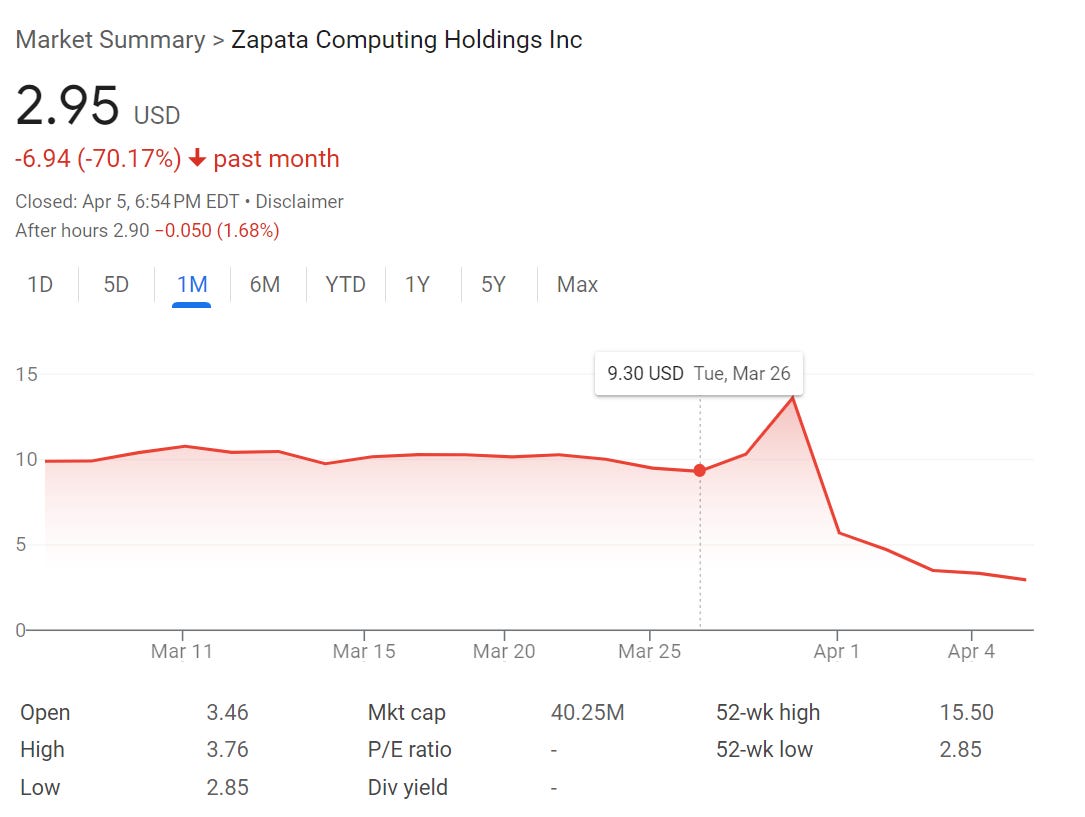
This event underscores the broader challenges faced by companies opting to go public through Special Purpose Acquisition Companies (SPACs), a trend that has been marked by heightened market volatility and investor hesitancy.
As Matt Swayne explains in his article for The Quantum Insider, due to a high rate of cash redemption by investors, the actual funds received by Zapata were substantially lower.
The redemption feature of SPACs, which allows investors to sell their shares back to the SPAC at the initial offering price, has contributed to this trend, with a median redemption rate of 96% observed in completed deals over the past year.
Founded in 2017 by Harvard researchers, Zapata initially focused on quantum computing, contributing to the development of quantum algorithms such as the Variational Quantum Eigensolver (VQE).
Despite shifting its primary focus to generative AI and optimization software, the company continues to advance its quantum computing initiatives, evidenced by the recent acquisition of patents related to quantum research.
Zapata boasts a prestigious clientele, including Sumitomo Mitsui Trust Bank, Banco Bilbao Vizcaya Argentaria SA, and BP Plc, illustrating its impact across various sectors.
In response to the market challenges, Zapata has engaged in strategic financial agreements to stabilize its position.
Among these is a partnership with Lincoln Park Capital Fund LLC, aimed at bolstering Zapata's balance sheet and ensuring liquidity. Additionally, a forward purchase agreement with Sandia Investment Management LP promises future financial support by setting terms for Sandia to acquire shares at a later date.
Christopher Savoie, CEO of Zapata, emphasized the advantages of being a public entity vs. a private one, highlighting access to diverse capital-raising strategies not available to private companies.
New $1.4 Billion Alliance Towards AI-Driven ADC Development
In a significant move to advance cancer treatment, Germany's Merck KGaA has established a strategic partnership with Caris Discovery, a technology-driven biotechnology company, focusing on the utilization of artificial intelligence (AI) in the development of antibody-drug conjugates (ADCs).
This collaboration, valued at $1.4 billion, is structured around an initial payment, alongside research funding, and encompasses a range of financial incentives including discovery, development, regulatory, and sales-based milestones, as well as royalties on sales for any marketable ADCs resulting from the alliance.
The collaborative effort is set to span several years, targeting the discovery and design of ADCs against up to 15 unique cancer targets.
Caris Discovery will lead the initial discovery and design phase of the ADCs, leveraging its extensive clinical and omics data repository, AI analytics capabilities, and the ADAPT Biotargeting platform.
This platform is instrumental in identifying variances in protein expression patterns between diseased and healthy individuals, potentially uncovering new biomarkers or drug targets. Upon reaching the preclinical development phase, Merck, through its U.S. subsidiary, EMD Serono, will assume responsibility for further development.
The partnership is a key component of Merck's strategy to enhance the productivity of its R&D operations, with an ambitious goal of launching a new product every 18 months. ADCs represent a critical aspect of Merck's future R&D endeavors.
Merck's current ADC pipeline features CEACAM5-targeted M9140, a leading candidate developed using Merck's proprietary platform, currently undergoing early-stage clinical trials for colorectal cancer and other solid tumors.
This collaboration with Caris Discovery follows Merck's termination of a previous agreement with Mersana Therapeutics, although Merck continues to engage with Mersana on a separate $830 million project focused on STING-agonist ADCs. Additionally, Merck recently opted into a collaboration with Jiangsu Hengrui Pharmaceuticals for a claudin18.2-targeted ADC.
The Unexpected Side-Effect of AI Progress in Drug Discovery: Prior Art Flood
Artificial intelligence (AI) is significantly impacting the pharmaceutical industry, serving as a catalyst for new drug discoveries, but it also presents some non-obvious problems for patenting experts: complication of the patent application process due to the creation of extensive AI-generated prior art.
The industry's engagement with AI spans drug design to molecule identification, with major pharmaceutical companies partnering with AI firms to enhance their drug discovery pipelines.
Prior art in the legal realm refers to any evidence that an invention is already known before a given date, potentially affecting its patentability due to lack of novelty.
Pharmaceutical companies are increasingly encountering AI-generated prior art during patent applications, a scenario where evidence suggests an invention is already known, thereby making it ineligible for patenting.
This phenomenon is raising concerns about the potential hindrance to innovation, as companies may be deterred from investing in R&D without the prospect of patent protection.
The novelty of an invention is a cornerstone of patent eligibility, and AI's capability to rapidly generate vast amounts of prior art is challenging this principle.
Legal professionals and academics highlight the paradox of AI in drug discovery. This issue is not just theoretical; litigation cases have already seen the use of AI-generated material to challenge patents.
The United States Patent and Trademark Office (USPTO) has recognized the need to address AI's role in the creation of prior art.
Although current guidelines permit the use of AI to assist inventors, they exclude purely AI-generated inventions from patent eligibility. However, the USPTO has yet to clarify how AI-generated prior art will be treated.
The pharmaceutical industry's reliance on patents to secure ROI on R&D investments is well-documented. With annual R&D expenditures exceeding $100 billion, the stakes are high. AI's potential to disrupt this investment by complicating the patenting process could have significant implications for drug development and public health.
This, of course, opens doors to various types of patent trolls, entities that acquire patents not to produce or further develop the underlying inventions but to profit from licensing fees or litigation against alleged infringers.
Legal experts suggest strategies to mitigate the impact of AI-generated prior art, including emphasizing human involvement in research and focusing on in-depth experimental data in patent applications.
Additionally, the concept of defensive publications—public disclosures intended to prevent others from patenting the same invention—is being explored as a countermeasure against AI-generated prior art.
Legal and regulatory frameworks will need to adapt to ensure that AI serves as a complement rather than a hindrance to innovation. The ongoing dialogue between the USPTO, legal professionals, and the pharmaceutical industry is critical to shaping the future of AI in drug development and patenting.
A Case of AI-enabled Target Discovery
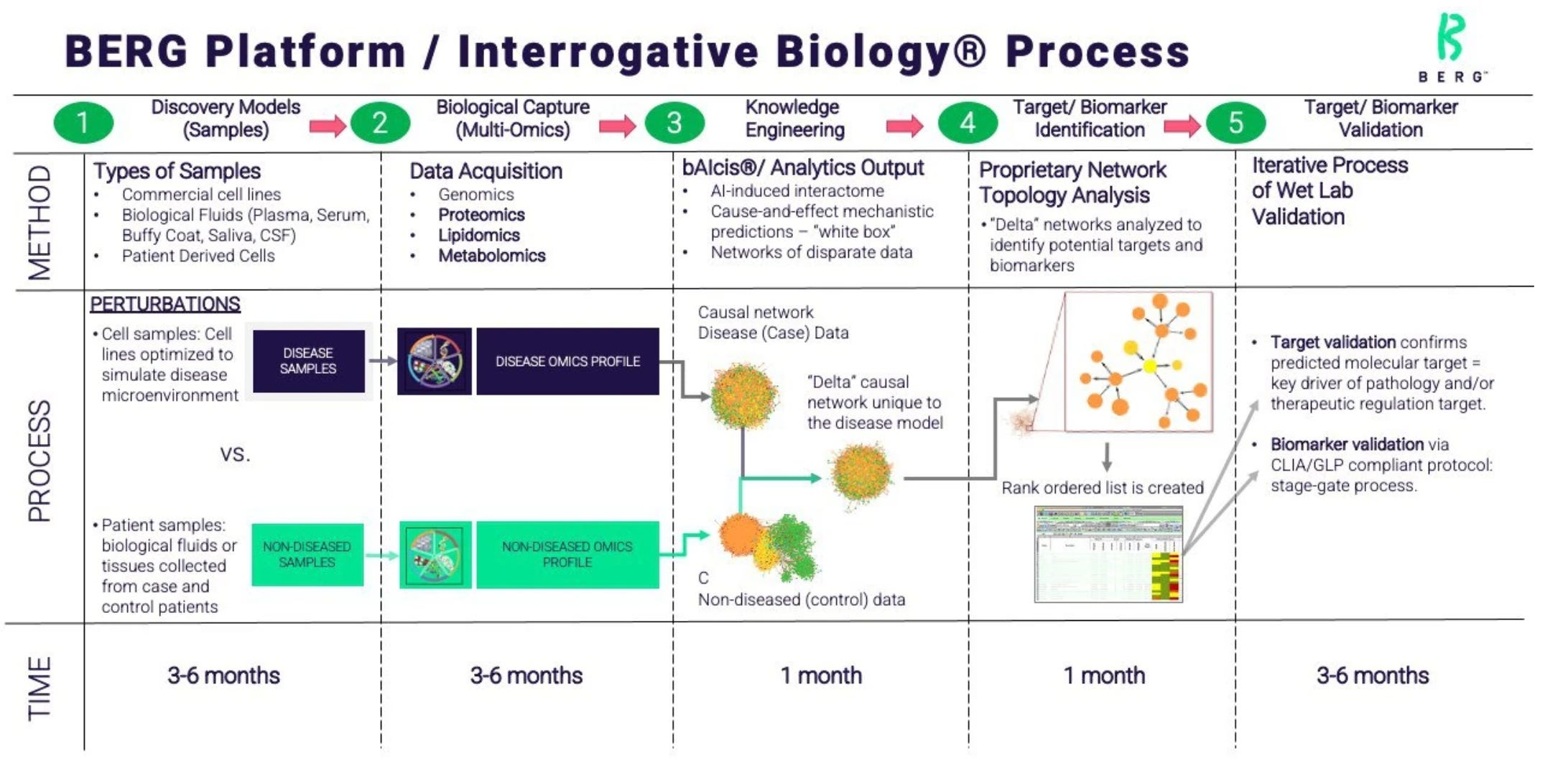
When I was researching Berg Health a while ago (they were acquired by BPG Bio in 2023), I came across a really neat infographic describing the process of AI-enabled ontology construction and target discovery, starting with some human samples to mine omics data.
The infographics depict the timeline approximation for such a process, which I guess is a good reference point to benchmark against other (legacy) R&D strategies:
BPGbio stands out in the biopharma sector by applying a Bayesian approach to artificial intelligence (AI), a method that's less common compared to the widely used machine learning techniques.
Bayesian methods leverage Bayes' Theorem to update the probability of a hypothesis as new evidence is introduced, effectively incorporating prior knowledge and observed data into a coherent framework of probabilistic inference.
These methods start with initial assumptions (priors) and refine these assumptions into updated probabilities (posteriors) based on new data, allowing for a dynamic and adaptable approach to modeling uncertainty.
Unlike fixed dataset-dependent machine learning techniques, Bayesian methods excel in situations where data is incomplete or uncertain, continuously evolving their predictions as more information becomes available.
This approach utilizes the enormous processing power of the world's first exascale supercomputer, Frontier, to analyze vast amounts of data from patients, reaching trillions of data points for each.
Through Bayesian networks, the company maps the intricate relationships between variables in large-scale multi-omics datasets, gaining deep insights into human biology and identifying new targets for drugs and diagnostics. This method allows for hypothesis generation directly from the data, avoiding the biases that can affect machine learning models trained on data with existing assumptions.
BPGbio's application of this method has already yielded promising therapeutic and diagnostic discoveries, including their lead program, BPM31510.
The company plans to conduct a Phase IIb study of BPM 31510 as a first-line therapy in combination with chemotherapy for pancreatic cancer.