From Biohacking to Healthcare: The Growing Pains of the Longevity Industry
Part I: A tour of the therapeutic strategies targeting the hallmarks of aging—from cellular reprogramming to senolytics, mTOR inhibitors, and immune rejuvenation
Our guest this week is Dr. Louise von Stechow with the first of a three-part deep dive into the longevity industry—the part of biotech trying to turn aging biology into actual drugs rather than supplement stacks and n=1 experiments. Louise is a pharma and biotech strategy consultant, host of the BioRevolution Podcast, and a regular BiopharmaTrend.com contributor; she's also spoken on AI in drug development at venues including Merck Healthcare's R&D Day.
Part 1 maps the therapeutic landscape by hallmark of aging. Parts 2 and 3 will follow on biomarkers and the consumer-facing clinic ecosystem.
Part I: Therapeutic strategies that target the hallmarks of aging
Recent developments suggest that the longevity industry is beginning to outgrow its infancy and move into a more mature formative stage. What started with academic aging research, biohacking, mouse studies, and occasional n=1 self-experiments is increasingly evolving into a well-funded biotech ecosystem focused on translating aging-related mechanisms into clinical development. A prominent example is Life BioSciences, the cell-rejuvenation company co-founded by aging researcher David Sinclair, which recently raised an $80 million Series D round to advance its first-in-human clinical program in optic neuropathies. Beyond cellular rejuvenation, a growing number of biotechs are developing therapies aimed at other hallmarks of aging, from senescence to metabolic dysregulation.
At the same time, despite these encouraging signs of momentum, the longevity industry still faces fundamental challenges, including the absence of a unified hypothesis of aging and the lack of robust proxy markers that can reliably measure biological aging and therapeutic impact.
The promise and challenges of the budding longevity industry
For most of human history, living longer mainly meant not dying early. Over the past two centuries, particularly in the 20th century, clean water and sanitation, improved nutrition, vaccines and antibiotics, and safer maternal, neonatal, and emergency care helped push average life expectancy up by decades.
In many high-income settings, however, the pace of improvement has slowed since the 1990s, while at the same time the burden of chronic disease has increased significantly. This raises a new question: how can we live longer, individually and as a society, without simply shifting the burden into more years lived with chronic disease?
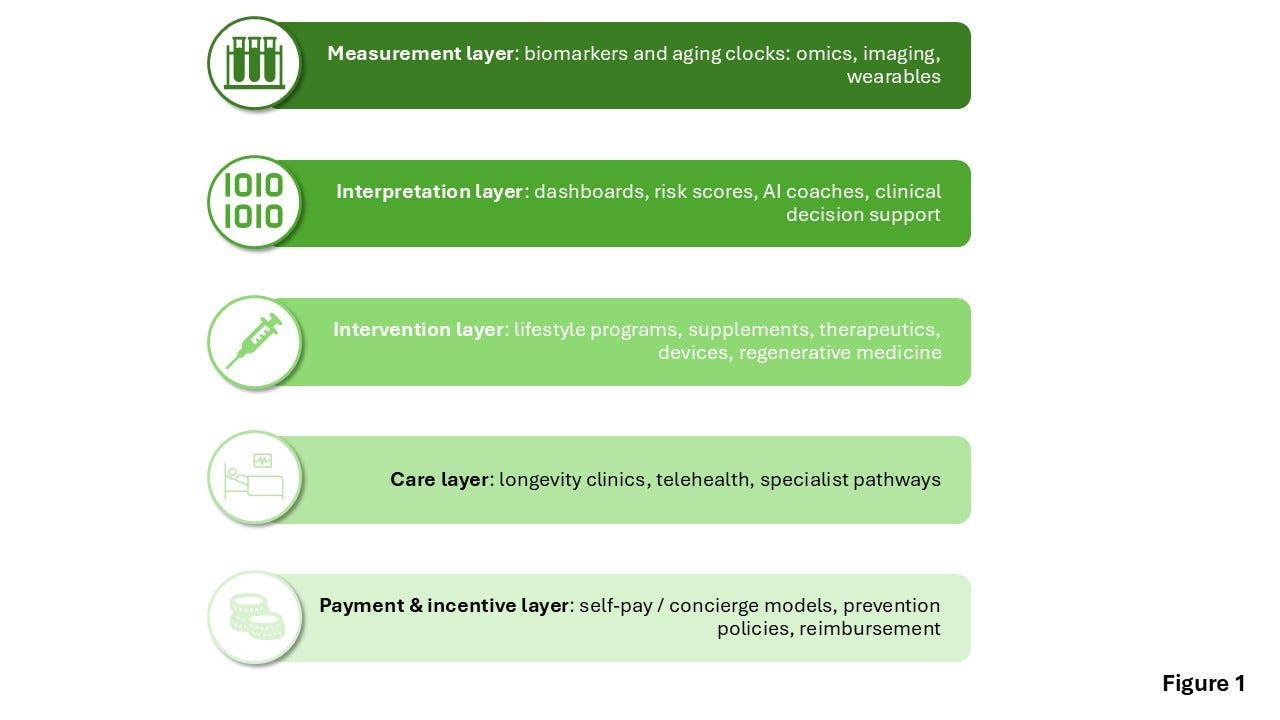
Researchers are increasingly reframing the problem away from purely disease-by-disease fixes and toward the underlying biology of aging that contributes to multiple conditions, such as cancer, cardiovascular, neurodegenerative, and metabolic disease. While the field is only beginning to untangle the complex, and likely multifactorial process of aging, a fledgling longevity industry has emerged around various hypotheses of aging mechanisms. This longevity stack spans different layers from biomarkers and aging clocks that aim to measure biological aging, to therapeutics that target aging-linked mechanisms, as well as care and delivery models (clinics, digital platforms, consulting) that package measurement and interventions into services (Figure 1).
The industry is supported by a growing ecosystem of specialized longevity capital firms, which emerged around the idea of aging biology as an investment opportunity. Alongside Sergey Young’s Longevity Vision Fund, firms like, Apollo Health Ventures and Healthspan Capital and others are building portfolios of companies that aim to tackle the root causes and accompanying symptoms of aging. At the same time, non-profit organizations, such as Hevolution, Lifespan Research Institute and the Methuselah Foundation are offering grants and partnerships to foster breakthroughs in the longevity field, while the XPRIZE competition offers $ 101 M over 7 years for teams that develop longevity therapeutics.
However, biotechs in the longevity space face major scientific and regulatory hurdles. On the one hand, incomplete understanding of which mechanisms are causal drivers versus downstream effects of aging challenges hypothesis selection for new treatments and aging markers. On the other hand, the lack of standardized, validated biomarkers and endpoints make it hard to select the right proxies for early readouts of aging. Notably, aging itself is currently not classified as a disease indication within a regulatory approval pathway.
In part 1 of this three-article series, we explore therapeutic strategies that tackle the hallmarks of aging. In part 2, we’ll dive into aging biomarkers and biological clocks, and in part 3, we’ll analyze consumer-facing longevity companies and longevity clinics.
Therapeutic strategies for combatting aging
A number of biotechs and academic labs are tackling aging hypotheses, often organized in different iterations of the hallmarks of aging framework (Figure 2). Many of these approaches are still early-stage bets for improving life- and healthspan, and most are being tested in (age-related) proxy diseases, which offer validated endpoints and shorter development cycles.
Resetting cellular information: cellular reprogramming and rejuvenation biology
One major longevity strategy focuses on resetting cellular information through reprogramming. By reversing epigenetic drift, a process through which cells gradually lose proper gene-regulatory control, cellular reprogramming aims to shift cells from aged back to youthful phenotypes. First demonstrated by Shinya Yamanaka’s lab in 2006, reprogramming approaches are now being pursued by several well-funded biotechs, including Altos Labs, NewLimit, and RetroBiosciences.
Altos Labs launched in 2022 with around $3B in backing (some reportedly with prominent backing from Jeff Bezos and Yuri Milner) and a high-profile academic team, including stem cell researcher Juan Carlos Izpisua Belmonte, as Founding Scientist and Senior Vice President and Shinya Yamanaka, as a Senior Scientific Advisor. Altos centers on the hypothesis that partial cellular reprogramming can restore youthful function without erasing cell identity, but it has remained largely stealthy about its specific programs. In May 2025, Altos acquired senescence-focused Dorian Therapeutics.
A first example of clinical testing in the area of reprogramming is Harvard scientist David Sinclair’s Life Biosciences, which has cleared the IND for ER-100, a partial epigenetic reprogramming program for optic neuropathies and closed an $80 million Series D financing in April of 2026.
In pursuit of more effective reprogramming, several companies are leaning on artificial intelligence. NewLimit, Shift Bioscience and clock.bio, for example, use AI-driven approaches to better understand (epi)genetic programs of aging and improve reprogramming strategies. NewLimit focuses on reprogramming cells to a younger state using AI-guided discovery, with a near-term emphasis on liver-directed mRNA reprogramming. NewLimit, co-founded by Coinbase CEO Brian Armstrong, raised a $130M Series B in May 2025 to push lead programs toward the clinic. Shift Bioscience, a Cambridge (UK)-based company, uses generative AI and virtual cell approaches to identify gene programs in single-cell analyses that can rejuvenate cells. In October 2024, it raised a $16M seed round to scale the platform and advance targets toward drug development.
San Francisco–based longevity biotech Retro Biosciences (backed by OpenAI’s Sam Altman, who led a$180M at seed and reportedly participated in the company’s ~$1B Series A in 2025) has positioned AI as part of its strategy for designing rejuvenation factors. Retro has begun moving its first candidates toward human testing, with a program centered on autophagy (another hallmark of aging) having already entered phase 1 in late 2025.
Notably, some companies such as Turn.Bio and Pelage Pharmaceuticals are pursuing dermatology as a near-term, measurable indication for rejuvenation. Pelage Pharmaceuticals aims to reactivate or restore follicle function to counteract hair loss, and announced a $120M Series B in October 2025 to advance its lead program through clinical development.
Removing or neutralizing harmful aged cells: senotherapeutics
Senescence is the process by which cells undergo an often irreversible cell-cycle arrest. While beneficial in certain contexts, senescent or “zombie” cells can accumulate and drive tissue dysfunction through inflammatory signaling via the SASP (senescence-associated secretory phenotype), contributing to chronic inflammation (inflammaging) and age-related tissue decline. So-called senotherapeutics try to remove these cells (senolytics) or blunt their harmful signaling (senomorphics).
AI–techbio pioneer Insilico Medicine’s TNIK inhibitor, ISM001-055, which is currently being tested in idiopathic pulmonary fibrosis (IPF) has shown senomorphic potential in a recent study. ISM001-055 (rentosertib) is one of the first examples of an AI-designed small molecule advancing in human trials, with positive efficacy and safety readouts from a randomized Phase 2a study. By potentially attenuating cellular senescence, the drug could help suppress multiple aging-related processes, suggesting broader applications as a senomorphic therapy in age-related diseases beyond fibrosis.
Rubedo Life Sciences aims to tackle senescent cells by selectively inducing regulated cell death via ferroptosis. The company, which raised $40M in a 2024 Series A, has an AI-driven drug discovery platform that employs single-cell RNA sequencing to drive small-molecule design for senescence-specific targets. Rubedo’s lead program, RLS-1496, a first-in-class selective GPX4 modulator, will reportedly commence clinical testing in psoriasis, atopic dermatitis, and skin aging. SENISCA’s senotherapeutic platform builds on the hypothesis that senescent cells show dysregulated patterns of RNA splicing. The company that spun out of the University of Exeter (UK) announced £3.7M in seed financing to advance its splicing-modulation platform and early pipeline.
Another company that operated in the senolytic space was Unity Biotechnology. However, despite initial hints of efficacy for its senolytic program, UBX1325 (foselutoclax) for diabetic macular edema, a phase 2 trial did not meet its primary endpoint and the company is no longer operating, having finalized liquidation in September 2025.
Reframing the metabolic hub: targeting mTOR and nutrient sensing pathways
Genetic analyses, lifestyle intervention, and drug treatment experiments in animals have consistently pointed toward metabolic pathways as key players in longevity, sitting at a central hub between metabolic control, growth regulation, inflammation, and stress pathways.
mTOR inhibitors like rapamycin were among the first compounds recognized to improve longevity in mice and are widely used in the longevity biohacking community. Rapamycin’s impact on aging is currently being tested in a double-blind, placebo-controlled, multicenter trial in healthy, middle-aged companion dogs in scope of the Dog Aging Project. Companion dogs are seen as good models for human longevity due to metabolic and lifestyle similarities.
Companies like Cambrian and Aeovian Pharmaceuticals are testing mTORC1 inhibitors in age-related proxy diseases. Aeovian raised $55M in December 2025 to advance its lead, a selective, CNS-penetrant mTORC1 inhibitor in Tuberous Sclerosis Complex (TSC)-related epilepsy. Similarly, Cambrian recently announced up to $30.8 M in funding from Advanced Research Projects Agency for Health (ARPA-H) to develop its selective mTORC1 inhibitors, in line with the agency’s PROSPR program.
In addition to mTOR inhibitors, diabetes drugs like metformin and GLP-1 agonists have been linked to longevity in various contexts. While the large-scale trial of the diabetes drug metformin, TAME (Targeting Aging with Metformin), as a longevity-promoting factor is still awaiting recruitment, a number of studies in patients with metabolic syndrome or obesity have shown benefits of GLP-1s on metabolic comorbidities, which are often associated with age-related diseases, including reductions in major adverse cardiovascular events and kidney outcomes. However, a beneficial effect of GLP-1s on neurodegenerative diseases could not be confirmed in a Phase 3 trial for slowing Alzheimer’s progression. As pointed out in a recent commentary in Nature Health, rigorous testing of GLP-1 receptor agonists as antiaging drugs will be required to show if they live up to their potential.
Cardiometabolic health is recognized as a specific risk factor in the metabolic pathways of aging. BioAge Labs employs its platform linking longitudinal multi-omics with healthspan trajectories (with aging cohorts followed for up to 50 years) to find druggable targets that are linked to metabolic aging. The company recently refocused on its early-stage, broader cardiometabolic aging pipeline including NLRP3 inhibition, after its lead obesity asset (azelaprag) showed liver toxicity signals in a Phase 2 study months after the company’s $238M IPO in late 2024.
Other biotechs in the cardiometabolic space are specifically targeting atherosclerosis as an age-related disease. For example, Cyclarity Therapeutics is built around the hypothesis that clearing arterial cholesterol toxins can reverse atherosclerotic disease biology. In Jan 2025, it announced the first tranche of a Series A and a first-in-human study for UDP-003, a candidate aimed at addressing cardiovascular risk via this mechanism. Repair Biotechnologies is developing first-in-class therapies that could reduce atherosclerotic plaque by selectively clearing excess intracellular cholesterol. The company is developing its mRNA therapy REP-0003 for Homozygous Familial Hypercholesterolemia, a rare condition of accelerated atherosclerosis, and received FDA Orphan Drug Designation in May 2025.
Restoring cellular bioenergy: mitochondrial function
Mitochondrial dysfunction is an aging hallmark and interacts with multiple other hallmarks. Bioenergetics restoration approaches target mitochondrial function and energy production to improve resilience in age-related disorders. Pretzel Therapeutics targets diseases where mitochondrial dysfunction is causal, based on the hypothesis that restoring mitochondrial function and mtDNA maintenance can treat rare mitochondrial diseases and may translate into broader age-associated conditions. In April 2025, the biotech initiated Phase 1 recruitment for PX578, a first-in-class approach targeting mitochondrial DNA polymerase. Similarly, MitoRx Therapeutics’s mitochondrial metabolic modulation platform has the potential to address obesity and other key cardiometabolic diseases. An interesting approach toward improved mitochondrial function is being taken by California-based startup mitrix. The company aims to grow mitochondria in large quantities in a bioreactor, with the goal of targeted, organ-specific replacement of functional mitochondria, with initial exploratory human testing started in 2025, including a 90-year old physics professor emeritus from the University of Washington.
Reinstating immune function: Targeting age-related immune dysfunction and stem cell exhaustion
Aging is often accompanied by innate and adaptive immune dysfunction (a process termed immunosenescence), which leads to higher infection susceptibility and lower vaccine efficacy. Moreover, systemic, low-grade inflammation levels (inflammaging) constitutes a major risk factor for aging-related diseases, linked to senescence and metabolic aging hallmarks.
Immunis, which announced a $25M Series A-1 in January 2025, is developing therapies to tackle failure of immune-regenerative signaling in aging-related disease. Philadelphia-based biotech Tolerance Bio aims to develop therapies for immune-mediated diseases, by exploiting the function of the thymus as a key regulator of immune tolerance. The company, which launched with $17.2M in seed financing in October 2024 plans to develop both cell-based therapeutics and RNA-based therapeutics for age-related disease in collaboration with Zipcode Bio. Similarly, TECregen, Thymmune Therapeutics and Intervene Immune aim to explore thymus biology to counteract age-related immune decline. Swiss biotech TECregen, which launched with $12.6 M (CHF 10 M) seed financing set out to develop thymopoietic drugs that restore immune balance, and address immune decline caused by aging.
A number of companies such as HERVolution Therapeutics and Transposon Therapeutics target mobile elements within the dark genome that can become reactivated with age or disease, from remnants of ancient retroviral infections to autonomous retrotransposons. Copenhagen-based HERVolution raised $11.7M in Series A to advance immunotherapies targeting human endogenous retroviruses (HERVs) in December 2024, while Transposon was awarded $22M by the ARPA-H for its lead TPN-101 to be developed under the PROSPR program.
Other companies, such as ImmuneAge and MoglingBio tackle immune function upstream by employing strategies for rejuvenating hematopoietic stem cells. German startup Mogling Bio is developing pharmacological rejuvenation strategies for restoring the function of “exhausted” hematopoietic stem cells. The company targets the small GTPase Cdc42, which becomes hyperactive with age, following the hypothesis that normalizing age-associated Cdc42 overactivation could help recover stem cell polarity and function. Downstream, this strategy could improve blood and immune cell quality, positioning stem cell rejuvenation as a potential intervention lever for immunosenescence.
Taming chronic inflammation: Targeting inflammaging as a driver of age-related disease
Other companies, such as Utah-based startup Halia Therapeutics, which raised $30M in a Series C in January 2024 tackle inflammaging, by targeting key players in inflammatory cascades. The company’s lead asset, ofirnoflast (HT-6184), is a NEK7-based modulator of NLRP3-mediated inflammation. The compound received Orphan Drug Designation from the FDA for myelodysplastic syndromes (MDS) in October 2025, with positive Phase 2a data presented at ASH 2025.
Alphabet’s Calico also just made a big bet on targeting inflammation in age-related disease. To complement its portfolio, which includes a number of bets on age-related diseases and an age-related disease alliance (worth up to $3.5bn) with AbbVie, Calico inked a $596M deal (including a $25 million upfront) with Chinese antibody drug company Mabwell for its IL-11 inhibitor. The anti-inflammatory cytokine IL-11, which acts on the ERK–AMPK–mTORC1 axis, is upregulated in aging cells and its inhibition was shown to extend health- and life spans in animal models.
Another company that aims to tackle the intersection of inflammation and fibrosis is AI- and longevity-focused biotech Juvenescence. The company’s plasminogen activator inhibitor-1 (PAI-1), recently completed a phase 1 safety study and is supposed to enter a Phase 2 proof-of-concept trial planned for in patients with metabolic and fibrotic disease.
The future of longevity drug development
While a number of companies are centered around specific aging mechanisms, others such as Calico, Retro Biosciences, and Insilico Medicine are diversifying across different aging mechanisms and manifestations. Other companies focus on a specific mechanism that is potentially applicable across different aging-related diseases. LinkGevity is creating anti-necrotic drugs using AI-driven approaches. Elevian focuses on restoring youthful regenerative capacity in humans by exploiting the biology of GDF11, a circulating blood factor shown to increase neovascularization and neurogenesis in mouse brains, initially focusing development on stroke with potential for expansion into cardiometabolic and inflammatory disease.
Across varying hypotheses and modalities, the longevity biotech field appears to be converging on a pragmatic strategy that bridges the realities of drug development with the ambitions of increased life- and healthspans: prove a mechanism in a recognized (aging-related) disease, measure something that moves earlier than mortality, explore long-term potential for aging. Interestingly, as a near-term proxy for studying interventions for human aging, some biotechs like Genflow Biosciences, Loyal and Rejuvenate Bio are testing therapeutics in companion dogs as a potential “first approval” pathway for an explicit longevity indication Loyal (which gathered $100M Series C funding in February 2026) is testing its LOY-002 for healthier lifespan extension in senior dogs and announced FDA CVM acceptance of a key safety package for LOY-002 in January 2026. Rejuvenate Bio develops gene therapies in animal health, including a gene therapy for canine osteoarthritis. with a long-term vision that veterinary translation can de-risk platforms relevant to human aging biology.
Alongside drug-based geroscience interventions, a growing set of academic groups and companies such as Renewal Bio, BE Therapeutics, United Therapeutics, eGenesis, New Jersey-based Celularity and Bayer’s BluerockTherapeutics are pursuing regenerative and replacement approaches, based on the idea that some age-related disease can be addressed by restoring lost cells and tissue function (via stem cells or engineered tissues) or by replacing failing organs, including xenotransplantation approaches. Notably, regenerative medicine biotech Longeveron just reported improvement in age-related frailty from a phase IIb study of their allogenic mesenchymal stem cells therapy laromestrocel. In their publication in Cell Stem Cell in March 2026, the authors indicate a clinically meaningful, dose- and time-dependent increase in the 6-min walk test for individuals with frailty treated with laromestrocel.
In light of the growing burden of chronic disease and the socioeconomic payoffs of increasing human healthspan, investment in longevity should be a priority for healthcare systems worldwide. Indeed, initiatives like ARPA-H’s PROSPR program that recently dedicated over $144 M in funding to interventions intended to prolong resilience with age , and the European Innovation Council naming “Biotechnology for Healthy Ageing” among its 2026 Pathfinder Challenges, hint at increased public recognition of healthspan investments. At the same time, the public funding for aging-related research remains on shaky ground. The FY2026 President’s Budget request for the U.S. National Institute on Aging would reduce the institute’s funding by 40.5% compared with the FY2025 level. To truly put longevity on the agenda of healthcare systems, public and private investments that foster longevity therapeutics as well as preventative strategies will be key.


