Where Tech Meets Bio

Where Tech Meets Bio

Deep Dives

The €25B vs €219B Problem: Europe's Plan to Fix Biotech

Brussels is counting on new laws, sovereign AI, and billions in fresh capital to close the gap. The clock is ticking.

BiopharmaTrend's avatar
BiopharmaTrend
Mar 07, 2026
∙ Paid

Between 2015 and mid-2025, EU biotech startups attracted €25B in venture capital. In the US, that figure was €219B. To turn things around, Brussels is counting on a legislative package.

Shortly prior to last Christmas the European Commission published a proposal of a European Biotech Act, a strategic initiative aimed at setting up a regulatory framework to strengthen the life sciences sector across the EU. The document has been mostly positively received by the sector leaders as a needed step towards fostering local biotech innovation. Brussels isn’t stopping there. Commission President Ursula von der Leyen pitched EU-Inc, a pan-European company structure meant to solve what many see as the EU’s core startup problem of navigating 27 different bureaucratic regimes. The proposal would let one register in 48 hours, fully online and in English.

The Case for Urgency

Why does it matter? Europe gave the world its first blockbuster pharmaceutical (Aspirin in 1899) and just 30 years ago produced half of all new treatments globally. Today, that share has fallen to just one in five. Even though the EU biotech industry has grown twice as fast as the overall union’s economy over the last decade, it struggles to convert the world’s top science into commercially viable products.

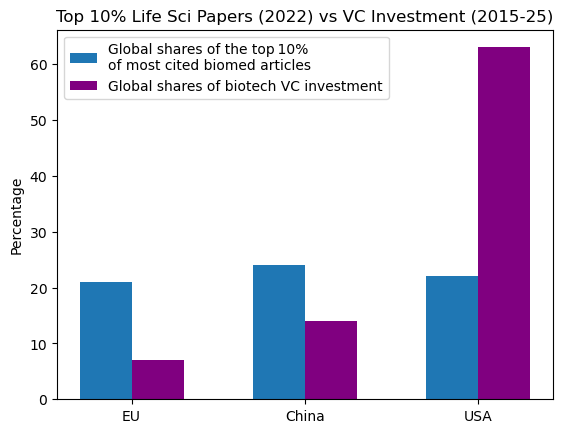
Europe holds a comparable share of the top 10% most-cited biomedical research to the US and China, yet lags significantly behind in venture investment — a gap caused by underdeveloped private equity markets and fragmented, complex regulatory frameworks. The disparity is also visible in listing trends, with 66 of the 67 EU companies that went public over the past six years choosing foreign stock exchanges.

Comparison of the global shares of elite biomedical scientific output and global shares of biotech VC investment between EU, China and US. Source of the data: European Biotech Act
To address this, the Biotech Act includes measures like:

  • Improve start-up access to finance;

  • Extend patent protection for eligible biotech medicines developed and partly manufactured in the EU;

  • Force EMA to develop tailored guidance for biosimilars, potentially reducing clinical data requirements.

The AI Gap

Among the points listed in the Act, authors claim the EU must utilize AI to accelerate the growth of the biotech sector. This rhetoric is unsurprising, as the legal framework and key provisions were already outlined in the 2024 AI Act.

The EU AI Act became the world’s first thorough regulation on AI, which took the world by storm after the release of ChatGPT in 2022. Although it is very ethically inclined, focusing on AI’s safety, traceability and transparency, such regulation slows down AI integration in biotech and other industries in the region. In late 2024, NVIDIA CEO Jensen Huang remarked that Europe was falling behind the United States and China in AI investment, a point later echoed by French President Emmanuel Macron. To top it off, unlike biomedical articles, Europe can’t hold a candle to China or the US in AI research output. According to Stanford’s AI Index report, U.S.-based institutions produced forty notable AI models in 2024, China got fifteen whereas Europe created only three.

Nevertheless, the AI adoption in Europe keeps increasing. While only 7.7% of businesses employing over ten people had used AI in 2021, in 2025 this number rose to 20%.

Source: 20% of EU enterprises use AI technologies - News articles - Eurostat; CC BY 4.0

Corporate Edge

This post is for paid subscribers

Already a paid subscriber? Sign in
© 2026 BiopharmaTrend (BPT Analytics Ltd) · Privacy ∙ Terms ∙ Collection notice
Start your SubstackGet the app
Substack is the home for great culture