

In late January, AstraZeneca announced a $15B investment in China through 2030, expanding R&D on Chinese soil with more manufacturing, and a focus on cell therapies and radioconjugates. The expansion builds on AstraZeneca’s long-running China footprint, which began in 1993 and currently runs two R&D centers in Shanghai and Beijing.
In this issue: From Generics to Innovation — Five Growth Stats — Company Radar — Rise & Constraints
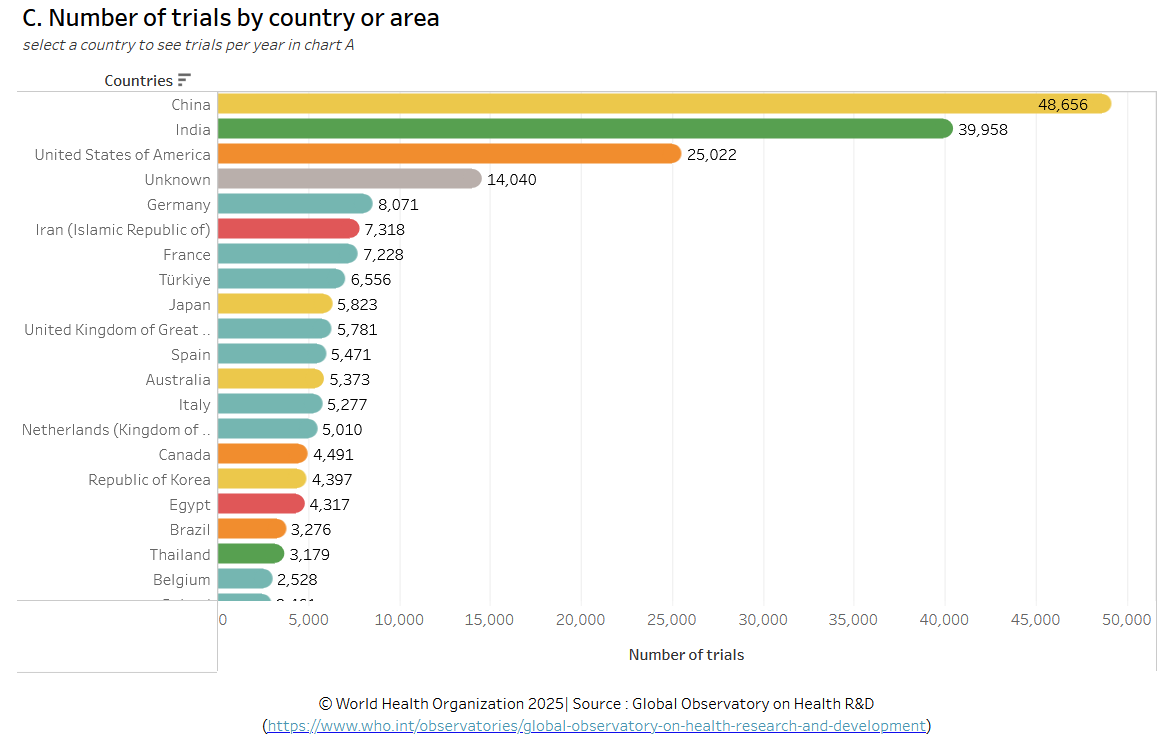
In DealForma’s figures cited by CEO Chris Dokomajilar, deal flow between large-cap biopharma and Chinese biopharma accelerated in 2024-2025. In 2025, big pharma completed 18 in-licensing and asset purchase deals (just one in 2020) from Chinese companies with $50M+ upfronts, totaling $57.3B in deal value and $3.9B in upfront cash and equity. By 2026, China continues to emerge as a major source of globally licensable, clinical-stage biotech assets, backed by an increasingly complete innovation stack, even as new policy constraints complicate cross-border data flows and outsourcing.
In late January, speaking at the Asian Financial Forum in Hong Kong, executives from Merck and Amgen pointed to China as a likely early approval market for fully AI-designed drugs. Merck China president Marc Horn suggested that 2026 could mark the shift from AI-assisted discovery to compounds designed end-to-end by AI entering regulatory pipelines, citing China’s patient datasets, clinical execution, and the government’s recent “AI Plus” policy push. Amgen’s chief medical officer Paul Burton pointed to a similar timeline, seeing 2026 as a year when AI-driven and human genetics–led discovery could begin translating more directly into drug candidates.
For perspective, among recent big pharma deals involving Chinese companies, this year’s JPM week had AbbVie’s $5.6B partnership with RemeGen around a bispecific oncology asset. Looking back at just 2025, Pfizer licensed a bispecific from 3SBio with $1.25B upfront, AstraZeneca entered a multi-year $5.3B AI-enabled small-molecule discovery collaboration with CSPC Pharmaceuticals, and GSK’s x Jiangsu Hengrui agreements included $500M upfront and up to about $12B in potential milestones.