А couple of weeks ago, our co-founder Andrii Buvailo, PhD outlined three main conclusions about the modern aging research landscape, drawing on discussions from ARDD2025 in Copenhagen, where he was present. Among other ideas, he makes a point that the recent conversion of aging research from theoretical into practical realm is heavily driven by AI, which is enabling better biological modeling, sharper insight into aging, and new ideas for confronting humanity’s core limitation.
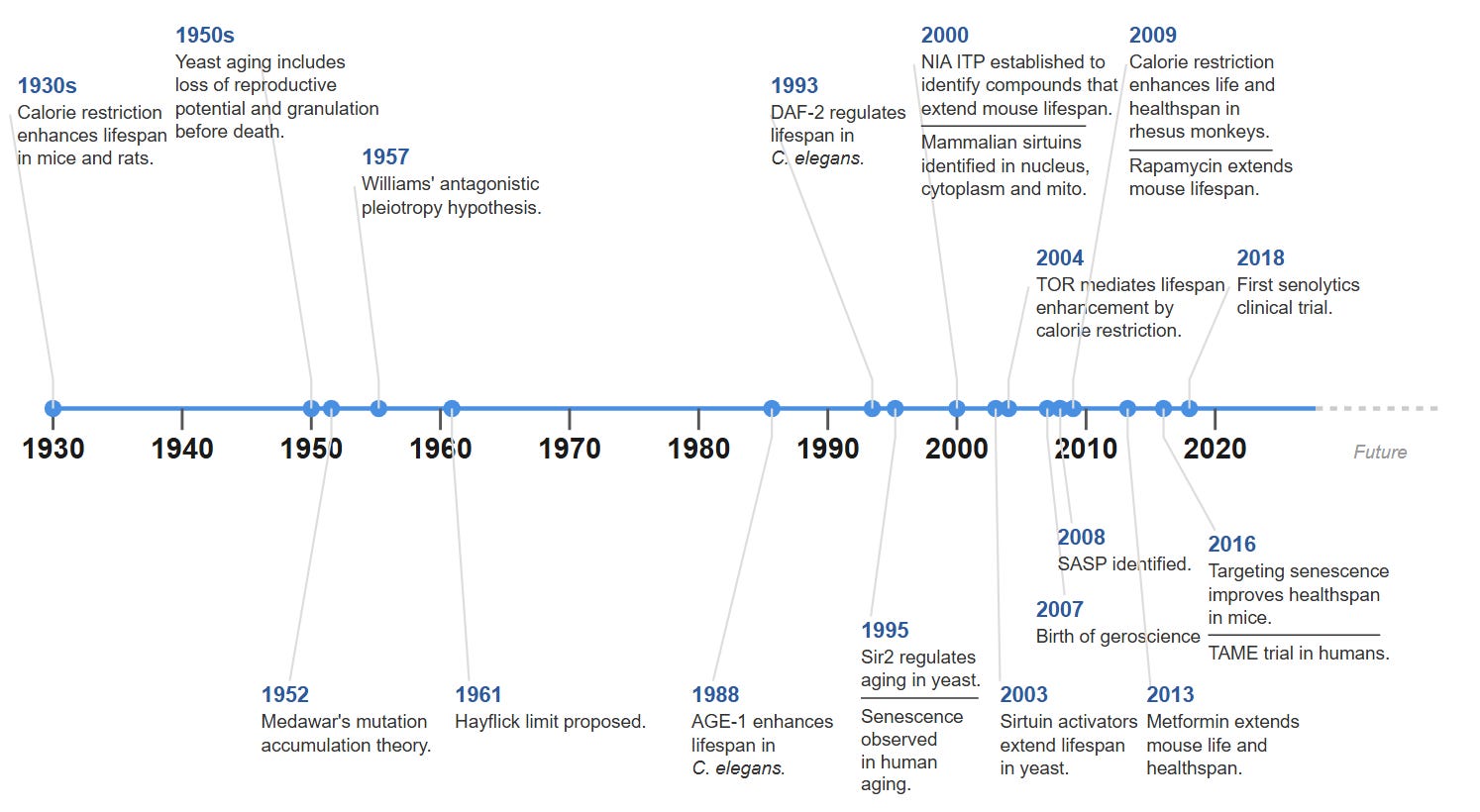
There are other speakers highlighting the promises of AI for solving aging. Anthropic CEO Dario Amodei said at 2025 WEF that if AI dramatically accelerates biological research, doubling the human lifespan by around 2030 isn’t unrealistic because it could compress “100 years of progress” into 5–10 years. Such claims are controversial, but they reflect a real trend: AI is impacting both basic geroscience and emerging longevity medicine. Before delving deeper into the intersection of AI and longevity, let’s overview the history of this field before machines came.
In this article: Nothing Lasts Forever — Aging Hallmarks & AI — Seeking Philosopher’s Stone — To Practical Longevity
Nothing Lasts Forever
Aging is the gradual, time-dependent decline in the physiological functions required for survival and reproduction. Unlike age-related diseases (such as cancer or heart disease), the defining features of aging are shared by all individuals within a species.
As an integral part of life, aging has caused a multitude of philosophical disputes throughout history, tracing back to 350 BCE when Aristotle first tried to explain senescence, viewing it as a ‘natural illness’. However, conventional aging research started much later, in the 20th century.