
Hi! I am Andrii Buvailo, and this is my weekly newsletter, ‘Where Tech Meets Bio,’ where I talk about technologies, breakthroughs, and great companies moving the biopharma industry forward.
If you've received it, then you either subscribed or someone forwarded it to you. If the latter is the case, subscribe by pressing this button:
Now, let’s get to this week’s topics!

Weekly tech+bio highlights
🔬 AlphaFold 3, developed by DeepMind and Isomorphic Labs, introduces major advancements in predicting the structure of a broad range of biomolecular systems, including ligands, RNA, DNA, and protein interactions (more on this below).
🔬 Lund University researchers successfully implant 7 million lab-grown brain cells into a Parkinson's patient, marking a world-first in treating the disease with cell therapy, significantly improving the patient's mobility and sensory functions.
🚀 Prologue Medicines launches with $50M from Flagship Pioneering, aiming to develop therapies using the untapped potential of viral proteins, exploring their application in immunology, oncology, and metabolic diseases with their DELVE platform.
🔬 Google's Connectomics team celebrates ten years with a groundbreaking publication in Science, detailing the synaptic-resolution reconstruction of human brain tissue. Their research, using advanced ML algorithms, reveals new neuron structures and synaptic connections, potentially transforming our understanding of brain function and disorders.
🔬 Researchers at the University of Miami have developed a therapeutic nanoparticle that penetrates the blood-brain barrier, targeting both primary and metastatic brain tumors. Published in the Proceedings of the National Academy of Sciences, their study demonstrates the potential of dual drug-loaded nanoparticles to shrink tumors and extend survival in preclinical studies.
🔬 Oregon Therapeutics partners with Lantern Pharma in an AI-driven strategic collaboration to enhance the development of XCE853, a novel PDI inhibitor showing promise in preclinical cancer studies. Utilizing Lantern's RADR® AI platform, the collaboration aims to optimize drug development strategies by identifying biomarkers and resistance mechanisms, potentially accelerating XCE853's path to clinical trials.
Hype Around AlphaFold 3
So, the biggest news of the week is that DeepMind and Isomorphic Labs, two of Google’s core AI subsidiaries, have launched AlphaFold 3, a brand-new AI model that builds on the success of their previous model AlphaFold 2, and can predicts molecular structures with even higher accuracy, and isn’t only restricted to proteins.
In fact, AlphaFold 3 manages proteins and their interactions with ligands, ions, DNA, RNA, and more. Let’s summarize some of the actual improvements (as per disclosed information):
Achievements of AlphaFold 3
Broader Molecular Predictions: Unlike AlphaFold 2, which primarily focused on predicting protein structures, AlphaFold 3 expands its scope to predict interactions between proteins and a wide array of other molecules, including DNA, RNA, and small molecule ligands. This comprehensive capability allows for a more complete understanding of cellular processes at the molecular level.
Improved Accuracy: AlphaFold 3 significantly enhances prediction accuracy. For protein interactions with other molecule types, the accuracy has improved by at least 50% over existing methods. For certain critical types of molecular interactions, the accuracy has even doubled. This leap in precision marks a substantial improvement in the tool's utility for scientific research and pharmaceutical applications.
Innovative Architecture and Processing: The model incorporates an evolved version of the Evoformer, a deep learning architecture that was fundamental to the success of AlphaFold 2. Additionally, AlphaFold 3 employs a diffusion network to assemble its predictions, similar to those used in AI image generators. This method begins with a cloud of atoms and iteratively refines their arrangement to achieve a highly accurate final structure.
Utility in Drug Discovery: AlphaFold 3's enhanced capability to accurately predict how drugs and other therapeutic molecules interact with proteins opens up new avenues in drug design. This is particularly vital for understanding complex interactions in the human body and designing new drugs that can effectively target specific proteins or molecular pathways.
Comparative Advancements Over AlphaFold 2
Scope of Molecular Interaction: AlphaFold 2 was a revolutionary tool for predicting the structure of proteins in isolation or in simple complexes. AlphaFold 3 extends this to a full spectrum of biomolecules, enabling a holistic view of cellular machinery and interactions. This broader scope is critical for understanding complex biological processes and diseases.
Computational Efficiency and Accessibility: With the launch of the AlphaFold Server, AlphaFold 3 is made accessible to a wider scientific community, facilitating easy and free access to its capabilities. This server enables researchers, regardless of their computational resources or expertise in machine learning, to model complex molecular structures and interactions.
Practical Applications and Collaborations: While AlphaFold 2 laid the groundwork for understanding protein structures, AlphaFold 3 is directly applied in real-world scenarios, particularly in drug design. Collaborations with pharmaceutical companies, such as those undertaken by Isomorphic Labs, are utilizing AlphaFold 3 to tackle real-world drug design challenges, potentially leading to new treatments for diseases.
Limitations, concerns
Now, I don’t need to explain how cool the new Alpha Fold 3 is, because pretty much every mainstream media outlet has already done it with fanfares.
Let’s talk about some nuances instead, outlined in broad strokes in this MIT Tech Review article:
Accuracy and Reliability: While AlphaFold 3 shows improvements in certain areas, its accuracy varies significantly depending on the type of interaction being modeled, with success rates ranging from 40% to over 80%. For some specific interactions, like protein-RNA, the model is noted to be quite inaccurate.
Risk of Hallucination: The use of diffusion techniques, while innovative, introduces the risk of the model hallucinating — generating plausible but non-existent structures. Even though more training data has been added to mitigate this risk, it hasn't been completely eliminated.
Restricted Access: Unlike AlphaFold 2, which had its code released as open-source, AlphaFold 3 will not have its full code publicly available. Instead, Google DeepMind will provide access through the AlphaFold Server, which limits experimentation to non-commercial purposes and restricts the types of molecules that can be studied. This restricts broader utilization and independent verification or modification by the research community.
Impact of Access Limitations: The decision to not release the full code and to impose usage restrictions could hinder the widespread adoption and innovative application of AlphaFold 3 in the scientific community. It could also limit the model's potential impact, particularly in environments where commercial use could drive rapid advancements and applications.
Structure is not all
Beyond possible nuances with AlphaFold 3 itself, it is important to remember, that solving structural aspects, no matter how precise, is just a small bit of a drug discovery puzzle.
As Derek Lowe put it nicely:
“Structure is not everything. It's very useful, very good to have, and it will accelerate a lot of really useful research. But it does not take you directly to a drug, nor to a better idea about a target for a drug, nor to a better chance of passing toxicity tests, nor to a better chance of surviving oral dosing and the bloodstream and the liver.”
By no means am I a skeptic, though; I am totally impressed by the news and congratulate everyone behind the new achievement with the launch of AlphaFold 3.
Anyway, you can try and experiment at AlphaFold Server; a good place to start is to watch the demo.
4 Biotech Startups Developing Breakthrough Drug Modalities
In the dynamic world of drug discovery, companies must continually innovate beyond their existing drug portfolios and modalities. Relying solely on familiar modalities limits the potential to develop more effective treatments.
The industry now explores a variety of therapeutic strategies, from established monoclonal antibodies (mAbs) and RNA therapies to cutting-edge gene editing and cell therapies like CRISPR and CAR-T.
Additionally, the small molecule space is evolving with technologies like PROteolysis TArgeting Chimeras (PROTACs), targeted protein degraders (TPDs), covalent inhibitors, and macrocycles, which target complex molecular structures previously deemed 'undruggable.' These advances, including the potential for synergistic combinations of these modalities, underscore the necessity for continuous innovation in drug discovery, integrating new and established technologies to develop groundbreaking treatments.
Here is a great report by Revvity Signals, The Innovation Imperative: Pioneering New Modalities for Therapeutic Leadership, which provides a bird's-eye view of the trends in the space of novel modalities:
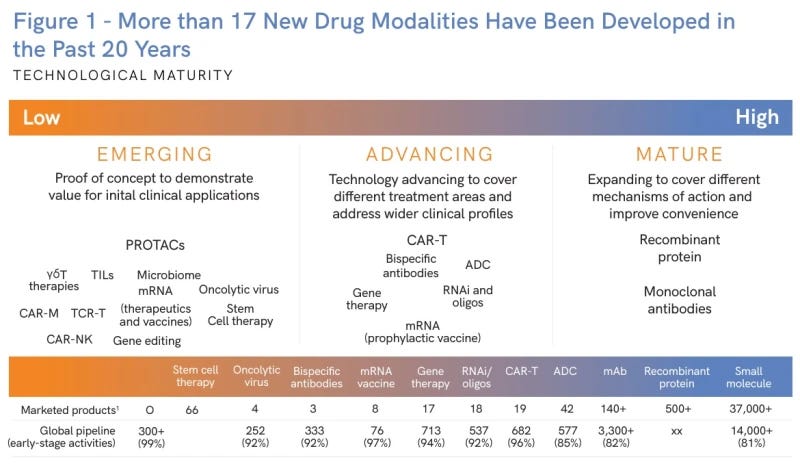
Below, we review four biotech startups developing platform-based approaches to design novel breakthrough modalities, including the integration of artificial intelligence (AI) into the process.
Orbis Medicines: nCycles
Orbis Medicines is a biotechnology company focused on pioneering a new class of orally bioavailable macrocycles, nCycles.
Macrocycles are a large and diverse family of compounds with highly desirable therapeutic properties, defined by the presence of a cyclic structure.
Orbis’ nGen platform is designed to systematically explore the macrocycle chemical space using a highly automated chemistry platform and deliver oral macrocycle drug candidates – nCycles – suitable for both intra- and extracellular targets. Orbis’ programs are focused on high-value oral alternatives to blockbuster biologic drugs and targets challenging for established modalities.
Orbis was founded in 2021 by the Seeds Investment team of Novo Holdings. In February 2024, the company announced its launch with a €26 million financing led by Novo Holdings and European life sciences venture firm Forbion.
Recently published research in Nature Chemical Biology demonstrates nGen's ability to deliver nCycles that are orally bioavailable, marking a new era for macrocycle drug discovery.
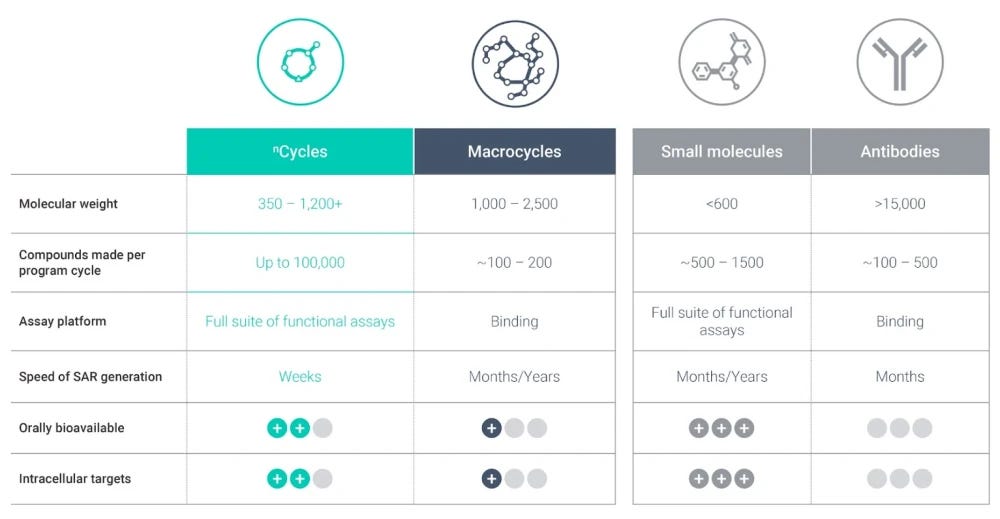
1. Technical Strategy: The nGen Platform
Automated Chemistry Platform: Orbis uses an automated platform for rapid synthesis of macrocycles. This allows for the creation of a vast array of macrocycle structures by combining both natural and synthetic amino acids. The system's automation supports the high-throughput screening of these macrocycles, efficiently narrowing down candidates with desired therapeutic properties.
High-Throughput Screening (HTS): HTS is central to nGen, facilitating the testing of up to 100,000 macrocycle compounds per design-make-test-analyze cycle. Each compound is assessed across multiple parameters including stability, binding affinity, and membrane permeability.
DNA-Encoded Libraries: Orbis employs DNA-encoded libraries (DEL) that boast nearly 100 billion compounds. These libraries are crucial for the initial hit finding phase, allowing the platform to screen a wide breadth of chemical space at an unprecedented scale.
Integration of Machine Learning: Machine learning algorithms are integrated within the nGen platform to process the vast datasets generated from HTS. This approach enhances the predictive modeling of compound efficacy and optimization, leading to accelerated cycle times and improved hit rates.
2. Innovative Approach to Macrocycles
Oral Bioavailability Focus: Traditional macrocycles often struggle with oral bioavailability due to their size and structural complexity. Orbis's nGen platform specifically aims to optimize macrocycles for oral administration by modulating properties such as size, solubility, and membrane permeability.
Diverse Macrocyclic Structures: Through the use of broad chemical diversity in its libraries and the flexibility of its synthesis platform, Orbis can explore a wide array of macrocyclic structures. This diversity is key to finding viable drug candidates that can mimic natural macrocycles like cyclosporine but with tailored properties for specific therapeutic targets.
3. R&D Focus and Future Prospects
Targeting High-value Biologic Drugs: Orbis’s initial focus is on developing oral alternatives to blockbuster biologic drugs. By targeting validated pathways with new orally active macrocycles, Orbis aims to provide treatments that are not only effective but also more accessible and easier to administer.
Broad Therapeutic Potential: The ability of nGen to generate macrocycles that can target both intra- and extracellular proteins expands the potential therapeutic applications. Macrocycles have the ability to interact with protein-protein interactions, which are crucial in many disease processes but often difficult for traditional small molecules or biologics to target effectively.
4. Technical and Market Differentiation
Speed and Scale: The technical capability of the nGen platform to synthesize and test large numbers of compounds rapidly provides Orbis with a significant competitive advantage. This allows for a faster iterative process in drug development, potentially reducing the time from discovery to clinical trials.
Data-Driven Discovery: The integration of real-time data collection with advanced analytics and machine learning creates a robust feedback loop that continuously refines the drug discovery process, enhancing both the efficiency and the success rate of producing clinically relevant compounds.
CatenaBio: Multi-Payload Conjugates
CatenaBio, founded in May 2021 and based on technology developed at the University of California, Berkeley, is a spinout from the Berkeley Labs, renowned for its groundbreaking CRISPR research.
CatenaBio is redefining the landscape of antibody-drug conjugates (ADCs) with their innovative Multi-Payload Conjugate (MPC) technology. This approach is distinct because it enables the attachment of multiple therapeutic agents with different mechanisms of action onto a single antibody. This versatility could potentially overcome limitations seen in traditional ADCs that typically carry a single type of drug molecule.
Their lead assets, as highlighted in their pipeline, include CATB-101 and CATB-102. CATB-101 is a validated antibody that carries two distinct therapeutic payloads. The details on CATB-102 remain undisclosed but it's also categorized under their novel MPC products, emphasizing the company's focus on creating complex therapeutics that can target solid tumors more effectively.
The technology behind these advancements, referred to as the CysTyr™ platform, utilizes the unique Catenase™ enzyme. This platform has demonstrated its ability to form diverse and novel biomolecule structures by facilitating conjugation reactions using only native amino acids. This capability allows CatenaBio to explore a vast chemical space that was previously inaccessible with conventional methods.
CatenaBio has presented their findings and innovations at prestigious venues such as the American Association for Cancer Research (AACR) Annual Meeting, indicating significant peer recognition and potential impact on future oncology treatments. Their presentations have included data showcasing the ability of their MPCs to combine multiple cell-killing mechanisms, a strategy aimed at enhancing the efficacy and precision of cancer therapies.
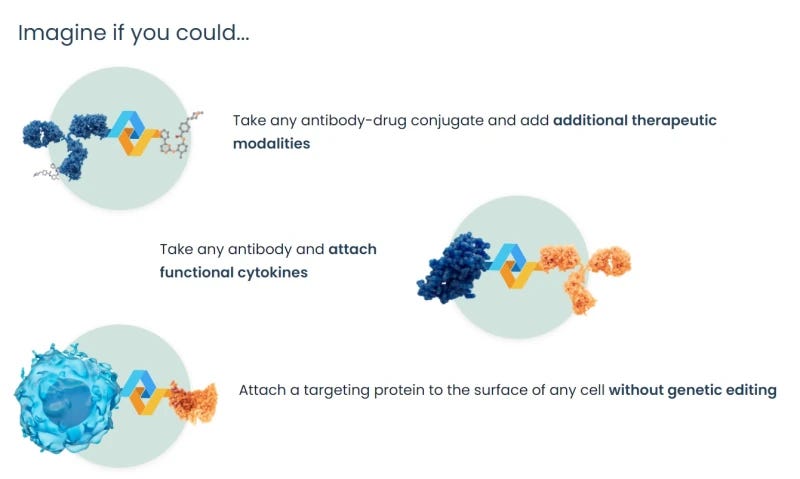
1. Technical Strategy: Multi-Payload Conjugate Technology
High-Precision Protein Targeting: CatenaBio's technology is based on creating MPCs that can simultaneously deliver multiple therapeutic agents. This approach uses the company’s proprietary CysTyr® platform, which allows for precise conjugation of different payloads to a single antibody, overcoming the limitations of traditional ADCs that typically carry only one type of payload.
Dual Payload Mechanism: The MPC technology differentiates itself by incorporating two distinct mechanisms of action (MOAs) in a single conjugate, potentially enhancing therapeutic efficacy against solid tumors. This strategy aims to address the limitations of single-MOA payloads, which can lead to therapy resistance or inadequate patient response.
Stable Drug-Antibody Ratio: CatenaBio's approach ensures a well-defined drug-antibody ratio, crucial for maintaining consistent pharmacokinetics and pharmacodynamics in clinical applications. The ability to control the ratio enhances the predictability and effectiveness of the therapy.
2. Innovative Approach to Conjugates
Therapeutic Flexibility and Design: The CysTyr® platform facilitates the fusion of novel biomolecules in any structure, combination, or orientation, dramatically expanding the chemical space available for drug development. This flexibility is pivotal for designing therapeutics that can effectively target complex diseases like cancer.
Rapid Design and Development: The MPCs can be designed in as little as two weeks, significantly reducing the development timeline compared to traditional methods that require lengthy drug screens to identify viable candidates.
3. R&D Focus and Future Prospects
Targeting Undruggable Disease Targets: By leveraging its platform, CatenaBio aims to develop therapies that can interact with previously 'undruggable' targets. This focus could revolutionize treatment options for diseases with high unmet medical needs, particularly in oncology.
Combinatorial Payloads for Enhanced Efficacy: The use of multiple payloads allows for a combinatorial approach to therapy, which could be more effective than single-agent treatments by attacking disease pathways at multiple points simultaneously.
4. Technical and Market Differentiation
Speed and Scalability: The CysTyr® platform’s capability for rapid and flexible drug design offers a significant competitive edge, enabling quicker transitions from the lab to clinical trials.
Data-Driven Development: CatenaBio’s approach is heavily reliant on computational tools and molecular profiling to inform and optimize the design of MPCs. This data-driven strategy enhances the precision of their therapeutic candidates, potentially leading to higher success rates in clinical settings.
Anima Biotech: mRNA-targeting Small Molecules
Anima Biotech focuses on designing small molecule drugs that modulate mRNA biology, a notoriously hard task. Normally, small molecules are designed to target proteins, but Anima’s drug modality is innovative by a mode of action.
Their approach involves targeting the processes that control mRNA behavior such as its translation into proteins, potentially affecting disease progression and symptoms.
This innovative approach aims to develop therapeutic agents that can either enhance or inhibit mRNA function, leveraging their platform to visualize and manipulate mRNA dynamics within cells. The drugs are designed based on extensive imaging data and AI analysis, identifying compounds that can beneficially modify mRNA activity.
Anima Biotech is advancing mRNA biology with its innovative mRNA Lightning™ platform, which incorporates AI-driven technologies to discover and develop mRNA drugs, targets, and vaccines.
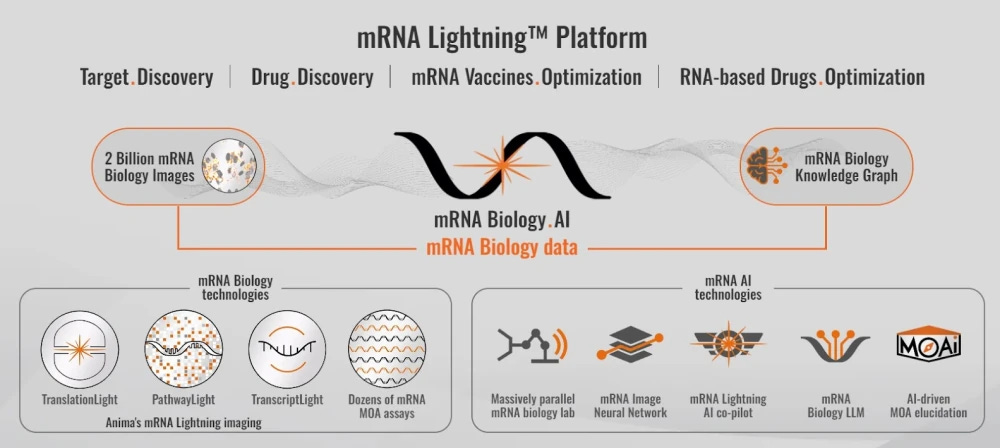
Here’s a breakdown of their approach and technological capabilities:
1. Technical Strategy: mRNA Lightning™ Platform
High-Content Imaging: Anima Biotech utilizes high-content imaging technologies to visualize the entire mRNA life cycle within cells. This technology allows for the generation of over 2 billion images of mRNA biology, which are crucial for training their AI systems.
Massively Parallel mRNA Biology Lab: The platform includes a massively parallel architecture that supports high-throughput screening. This lab conducts millions of biology experiments, rapidly testing hundreds of thousands of molecules to identify active compounds that can restore diseased cells to a healthy state.
AI Integration: Anima’s platform leverages AI to analyze the extensive visual data generated from their experiments. This includes an mRNA image neural network trained to recognize disease signatures and differentiate between diseased and healthy cellular states. The AI component is crucial for elucidating the mechanisms of action of potential therapeutic compounds.
2. Innovative Approach to mRNA Biology
Pathway Visualization: The platform enables detailed visualization of various mRNA regulatory pathways such as splicing, localization, and decay. Each pathway is monitored through specific imaging technologies that serve as visual readouts for pathway activities.
Rapid MOA Elucidation: The integration of AI with their extensive visual data aids in the rapid elucidation of the mechanisms of action of compounds, significantly speeding up the drug discovery process.
3. R&D Focus and Future Prospects
Broad Therapeutic Applications: Anima’s technology is applied across various therapeutic areas including Immunology, Oncology, and Neuroscience. Their pipeline includes promising candidates for diseases like lung fibrosis, solid tumors, leukemia, neuroblastoma, Alzheimer’s disease, and pain.
Strategic Pharma Collaborations: Anima has established key strategic collaborations with major pharmaceutical companies such as Lilly, Takeda, and AbbVie, enhancing the potential for development and commercialization of their discoveries.
4. Technical and Market Differentiation
Scalable Architecture: The mRNA Lightning™ platform is designed for scalability and ease of use, allowing seamless integration of biology, software, data analysis, and chemistry. This unified platform supports extensive project management and can handle billions of images, facilitating comprehensive mRNA biology research
Crosshair Therapeutics: D-Chain
Crosshair Therapeutics, established in 2021, is focused on creating a novel class of DNA-based therapeutics.
Their D-Chain Technology enables precision targeting of challenging disease targets that are often considered undruggable. This platform uses chain-like therapeutics that don't rely on traditional binding pockets, which allows for superior specificity and access to intracellular targets.
Crosshair also employs engineered adeno-associated viruses (AAVs) for precise drug delivery, which targets specific cell receptors or tumor-associated antigens, minimizing off-target effects and enhancing treatment efficacy. Their approach integrates personalized medicine, utilizing molecular profiling to inform custom therapy development.